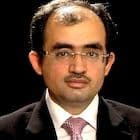
Interviews with Radwan Ziadeh
Syria
Background
“I think the Assad regime’s strategy in punishing not only human rights activists but also their families is the dark side of all our lives.”
Transcript
My name is Radwan Ziadeh. I’m a Syrian human rights activist born and raised in Syria, in Damascus. I left Syria in 2007 as a senior fellow at the U.S. Institute of Peace in Washington, D.C., where I wrote my first book in English about current policy in Syria. And also, I am glad that I returned to Syria at the same day I left Syria, but after five years [Ziadeh was exiled by the government for his human rights activism and opposition to Syrian President Bashar Assad]. I returned to Syria in September 2012, in the northern part of Syria. Of course, there are all of these parts being liberated by the Free Syrian Army [an armed opposition group in Syria established in 2011 to oppose Syrian President Bashar Assad] and all the crossing borders with Turkey being liberated.
It’s too easy to cross the border. It was very emotional visit, to visit your homeland after five years, with the same time, a lot of promising, but also a lot of challenges ahead of Syria. I admire the Syrian people. I never thought that there would be a revolution in my home country. I traveled in almost 80 countries around the world. I visited and studied the democratic transition in Latin American and Eastern Europe, in Southeast Asia, in Africa. And I dreamed for one day there should be democratic transition in my home country, in Syria. My father – my family – it’s just a middle-class family. My father is a teacher.
Then he became the manager of the school. But all my brothers, sisters also graduated from Damascus University. Now, we can see that a small family, who at the same time educated and middle-class – we have some difficulties from the cost of living rising in Syria, very limited opportunities of jobs, work and all of that. My father decided to go to Saudi Arabia to work there, but he returned to Syria in the ’90s. I grew up in Damascus. I graduated from Damascus University. This is very interesting because I’m a dentist. I graduate from faculty of dentistry in Damascus University in 1999. After that I continued my study as a surgeon. But I’ve never been interested, actually, to work – this is why when I graduated, I never practiced dentistry at all.
I became involved heavily in the human rights activities inside Syria. We established the first human rights organization in Syria in 2001, called the Syrian Human Rights Association, where 40 lawyers, activists, human rights activists established the human rights association. And that’s full-time work for me, even as I’m working as a volunteer with this organization. Four year later, I establish my own organization called Damascus Center for Human Rights Studies. Well, this organization became the leading organization in international lobbying. Go to New York, Geneva, the U.N. Human Rights Council, attending international events actually to raise awareness about the situation of human rights in Syria.
Well, that creates more problems for me when I used to go to Syria. But at the same time, the best tragic story in my family, that when I became as a human rights activist, active in politics in Syria, especially after Damascus Spring, I put all my family members at risk. It was my choice. And they have to be, unfortunately, the price with such regime that can take hostage of the whole family if you’ve been active in politics and human rights. When I left Syria in 2007, the Assad regime put a travel ban on all my family members, my mother, sisters, brothers. And I could not see them for almost five years because the travel ban – they cannot travel, and they cannot get back to Syria because the Assad regime – they issued an arrest warrant for me in February 2008.
The most difficult story was my sister’s story because her husband was in Saudi Arabia. He’s a physician working there. And she’s in Syria. She has five children and they’re all children. They don’t see each other, they don’t see their father, and now they’re blaming their uncle for putting all family members’ lives at risk. I was very sorry for them, and I think the Assad regime strategy is punishing not only the human rights activists but also their families – it was the dark side of all our life and the risk we take when we choose to work as human rights defenders.
About Radwan Ziadeh
Radwan Ziadeh is a Syrian dissident and democracy activist. He grew up in a middle class family in Damascus and became politically active after the death of President Hafez Assad in 2000. Remembering the struggles of his own family growing up, Ziadeh wanted to live in a free country and helped establish the Syrian Human Rights Association, a group dedicated to promoting human rights, in 2001.
Four years later, Ziadeh founded his own organization called the Damascus Center for Human Rights Studies. Through his center, Ziadeh acted as an international lobbyist for the cause of Syrian freedom. Speaking at venues like the United Nations Human Rights Council, Ziadeh raised awareness about the human rights abuses being committed by the Assad regime in Damascus. As Ziadeh intensified the spotlight on Syria, the government retaliated by placing a travel ban on his family, effectively imprisoning them in Syria, or stranding those traveling abroad in third countries. In 2007, Ziadeh fled Syria for the United States as the Assad government issued a warrant for his arrest.
Beginning in March 2011, the Syrian people revolted against President Bashar Assad, who had succeeded his father, challenging the government’s control over the country and resulting in a tense standoff between the remnants of the regime and diverse opposition forces. In 2012, Ziadeh seized the opportunity afforded him by the revolution and visited his homeland for the first time in five years. He continues to reside in the United States where he works through organizations like the Damascus Center for Human Rights Studies and the Syrian Center for Political and Strategic Studies to rebuild Syria into a free and democratic society.
Twitter: @radwanziadeh