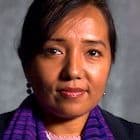
Interviews with Khin Lay
Burma
Triangle Women's Support Group
“Without the development and improvement of women, democracy is nothing.”
Transcript
I’m the founder of the Triangle Women’s Support Group. I did some of the women programs since 2011, but at that time, I’m not very – dared to be in public, not – I couldn’t do it openly at that time. But after – in 2011 – sorry – 2012 March 8 there is International Woman Day. So we announced our group openly, publicly, and we would do such kinds of women activities, and women’s empowerment programs through the channels and media.
And now, I mainly target women, to strengthen women and young women to engage in democratization, not only in politics, but also in public life. That’s why we give the awareness raising training and presentation to mothers and women, especially in a classroom level, because, you know, 60 percent of our population are women. Without the development and improvement of women, democracy is nothing. We believe like that. Our country will never develop. We believe like that. That’s why we try to encourage our women and to promote the status of our women to be engaged in a new situation.
So that’s why – and moreover, I give the career development training to the young women who are from 16 to 30. So I think there will be more investment coming in the future. Without the proper skill of our people, they won’t get a decent job. That’s why I try to teach them like computing, basic accounting, English classes, English language classes, like that. And compulsory courses about sex education, and, again, ethics, values. And also, now I make some of the events and organize some of the events like international visitor came to our country. And I made panel discussion, lecture, presentation.
So there is one of the think tank groups in [Washington] D.C., CSIS [Center for Strategic and International Studies], came to our country and I organized panel discussions with them and also Freedom House. During their visit, I made the advocacy training for the young activists. Because, you know, at that moment we were still – most of our people still live in – they still regarded themselves as activists. Not as advocates. So the situation is a little bit changed. [Being an] activist is still good, but we should advocate in some way. So demonstration is one of the two, but advocacy is also very effective in the future we believe like that.
That’s why we give the advocacy training. And also many – Professor Larry Diamond [prominent democracy scholar and Senior Fellow at Stanford University’s Hoover Institution] came to our country. We made the lecture, invited the young people to listen about democracy and transition. So I try to give the exposure to my new generation, what – the international community practice and democratic practice. I try to give them such kind of exposure, even though they can’t come up from the country to hear or something like that. But they have – they can get a little experience of the international exposure.
About Khin Lay
Khin Lay is a Burmese civil society and political activist. She was born in Yangon in 1971.
She pursued a career in education, hoping to be a university professor. That ambition changed after Aung San Suu Kyi, the leader of Burma’s democracy movement, inspired Khin Lay to take an active role in freeing her country. In 1995, Khin Lay joined Aung San Suu Kyi’s National League for Democracy (NLD).
As a member of NLD, Khin Lay endured constant surveillance by the regime. In 2000, she was arrested by authorities for her involvement with the party. After five days of interrogation in which she was blindfolded and deprived of sleep, Khin Lay spent four months in Insein Prison, a facility notorious for its deplorable conditions and use of torture. She was released in 2001.
More recently, Khin Lay has focused on strengthening women’s rights and building a more robust civil society. She founded the Triangle Women Support Group, an organization dedicated to empowering Burmese women, developing their political and professional skills, as well as encouraging greater participation in public life. She believes that fostering a new generation of strong, female leaders is a key component to Burma’s democratization.