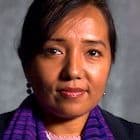
Interviews with Khin Lay
Burma
Background
Khin Lay discusses the roots of her activism.
Transcript
I come from a business family background. So my parents were businessmen before the 1988 students uprising [a protest that began when students clashed with the military over the regime’s economic policies]. After the 1988 uprising, the economic situation is totally different from the past. That’s why our life changed, not only in politics, but also in business. So, firstly, I intended to be a lecturer in a university. That’s why I studied to get a master’s degree in physics in Yangon University, an arts and science university. Now, recently Mr. President [Barack] Obama [44th President of the United States] came and gave a speech at that university [President Obama visited Burma in November 2012]. And after Daw Aung San Suu Kyi was first released in 1995, we usually went and listened to her speeches [Aung San Suu Kyi is the leader of the main Burmese opposition party, the National League for Democracy (NLD). She led the NLD to victory in the 1990 elections, but the military government ignored the results and put her under house arrest. She was awarded the Nobel Peace Prize in 1991].
She made a public speech in front of her friends every Saturday and Sunday. So after listening to her speeches again and again, I was really inspired and motivated to do politics in person. Previously, our family is a strong supporter of Daw Aung San Suu Kyi. As you know, that Daw Aung San Suu Kyi is the daughter of our independence hero, General Aung San. So we love her very much. Her father passed away when she was two years old, so we are very passionate for her and her family. That’s why we love her. As I said before, that after Daw Aung San Suu Kyi was first released in 1995, we listened to her talk publicly.
And I was really inspired and motivated to join NLD. But at that time, I was studying for my master’s degree. So after I finished my studies, I joined NLD full-time. But there is another reason I joined is that, firstly, I just attend and join and listened to the book club and many other activities they usually did in The Lady’s [Aung San Suu Kyi’s nickname] yard and headquarters. But I didn’t join full-time. But after 1997 and 1998, there was a, we call, operation. Thousands of NLD members got arrested, because, you know, at that time, Daw Aung San Suu Kyi announced that – they were called the people parliament [Committee Representing the People’s Parliament – a coalition of opposition forces] – if the authority didn’t recognize the result of the 1990 election, she would make some of the people parliament or some other activities if the government didn’t do it in time.
So from after this statement, most of the NLD members were arrested. So at that time, there were very few members who worked in headquarters, NLD headquarters. That’s why we decided, I and others, some of my colleagues decided to join NLD to work as a full-time volunteer.
About Khin Lay
Khin Lay is a Burmese civil society and political activist. She was born in Yangon in 1971.
She pursued a career in education, hoping to be a university professor. That ambition changed after Aung San Suu Kyi, the leader of Burma’s democracy movement, inspired Khin Lay to take an active role in freeing her country. In 1995, Khin Lay joined Aung San Suu Kyi’s National League for Democracy (NLD).
As a member of NLD, Khin Lay endured constant surveillance by the regime. In 2000, she was arrested by authorities for her involvement with the party. After five days of interrogation in which she was blindfolded and deprived of sleep, Khin Lay spent four months in Insein Prison, a facility notorious for its deplorable conditions and use of torture. She was released in 2001.
More recently, Khin Lay has focused on strengthening women’s rights and building a more robust civil society. She founded the Triangle Women Support Group, an organization dedicated to empowering Burmese women, developing their political and professional skills, as well as encouraging greater participation in public life. She believes that fostering a new generation of strong, female leaders is a key component to Burma’s democratization.