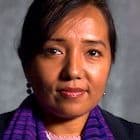
Interviews with Khin Lay
Burma
The 1988 Uprising and its Legacy
“The whole country would join the protest at the same time on 8/8/88”
Transcript
At that time, in 1988, I was a first year university student. So at that time, we didn’t know much about politics. We just knew that we have a very difficult economic problem. And you may have heard that there was a – how can I say that? Many illegal – the government announced that the money – about 100 kyats notes and 50 kyats notes [Burmese currency] are illegal or like that. So there are many complaints about being announced like that. And there are many other cases who felt that they don’t – they didn’t satisfy their government, but we have no ways to express our feelings. [The Burmese leader at the time, General Ne Win, compounded years of economic mismanagement by suddenly cancelling certain currency notes. He wanted only 45 and 90 kyat in circulation because they were divisible by nine, which he considered a lucky number.]
But in 1988, at the Yangon Institute of Technology School, there was conflict – there was fighting – we can say that – between the university students and the young people who lived in that ward – so there was a conflict. And according to the conflict, the government solved this problem by favoring the ordinary young people who are living in the ward. So he is one of the son of the chairman of this – “wardship” [township] – that’s why the government favored that youth group. That’s why the university students, engineering students, very – got angry and they fought each other. And the government cracked down very seriously.
That’s why one of the most prominent leaders, student leader, Phone Maw, died on the spot [he was shot dead during clashes with the military]. From that – this is the spark– and after that, there were any uprisings and many demonstrations, not only in the engineering university, but also in other regional colleges and the main university, we call Yangon University. So there were many uprisings that happened. And also, it is one of the most important one is the international radio channel, like BBC [British Broadcasting Corporation], VOA [Voice of America] – at that time, there was only two channels. So they also announced the uprising news, updated news so people knew about this news. And also they like to join in the protest, and after that – and they call that date 8/8/88 [August 8, 1988]. So there would be – the whole country would be in a protest at the same time on 8/8/88. So, on that time, there is a big march, a big protest happened in the whole country.
You know, we have seen many bad images and many bad things in the 1988 student uprising. Because we were –I was one of the students who make protests among the students. So we know very well how the military generals treated the students, not only the students but also the public who peacefully demonstrated without any arms, or without any weapons. So yeah. For the security reason, we have a – we were very afraid of being in jail or being shot by the soldiers. But for our future and for our country, it’s really – we are the very important people to continue to fight the military regime, because, you know, after – on that date, you know, 2000 to 2010, the new generation came out. Young people are very afraid to deal with – to engage with politics. You know, new generations never had or never even seen the 1988 uprising.
They don’t have any experience and no idea because although most of the state-owned media and newspaper – never allowed to express the news of the 1988 uprising. So the new generation, next generation never knows what was happened in the past. That’s why they are a little bit hesitant to join in politics. But for our generation, it is a 1988 so we know very well about the situation. And we – I myself regarded as we should do – at least in our family one people, one of the family members should do – should participate in politics to get the democracy in the first steps.
About Khin Lay
Khin Lay is a Burmese civil society and political activist. She was born in Yangon in 1971.
She pursued a career in education, hoping to be a university professor. That ambition changed after Aung San Suu Kyi, the leader of Burma’s democracy movement, inspired Khin Lay to take an active role in freeing her country. In 1995, Khin Lay joined Aung San Suu Kyi’s National League for Democracy (NLD).
As a member of NLD, Khin Lay endured constant surveillance by the regime. In 2000, she was arrested by authorities for her involvement with the party. After five days of interrogation in which she was blindfolded and deprived of sleep, Khin Lay spent four months in Insein Prison, a facility notorious for its deplorable conditions and use of torture. She was released in 2001.
More recently, Khin Lay has focused on strengthening women’s rights and building a more robust civil society. She founded the Triangle Women Support Group, an organization dedicated to empowering Burmese women, developing their political and professional skills, as well as encouraging greater participation in public life. She believes that fostering a new generation of strong, female leaders is a key component to Burma’s democratization.