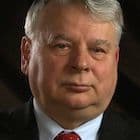
Interviews with Bogdan Borusewicz
Poland
Surviving Martial Law
“I was the first one on their arrest list.”
Transcript
The authorities did react, they made the decision, General [Wojciech] Jaruzelski [Poland’s last Communist leader who ruled from 1981-1989] decided to use force, but this was many months later, months of freedom and of the development of these independent organizations, which cropped up everywhere – even with the police, an independent labor union was being created. What was reborn were organizations of those involved in culture, the visual artists union, the literary union, the union of Polish Stage and Screen Actors, the Association of Journalists, all this took on a life of its own, and so by that time it was a grand movement. And by then the numbers involved were tremendous: When martial law [declared by Poland’s Communist government in 1981] was introduced, Solidarity [labor union formed by Gdansk ship builders] numbered about 10 million.
So it would be enough for only five percent to continue with activities, you are talking about a half a million people. I was part of that five percent, of course. Yes, I managed to evade being captured, I fled, it was not possible for the political police then to stop me – and so I began a long stint of my underground activity. I was in hiding, went around with a modified face, a modified physique, etc. I was in makeup, really, had another’s set of papers. Four years, four years and a month. So then I came back home. I had left home, fled from home, the night of December 12th [1981], even before martial law was formally announced – because I was the first one on their arrest list. They came for me even before martial law’s formal enactment. So you can say, I stepped out of my home on December 12th [1981], and I stepped back in after five years.
Because in addition to the period when I was hiding and spent it underground, I was also arrested and spent a certain time in prison. So I came back home after nearly five years. At the time, immediately after escaping, I organized another strike at the Gdansk Shipyard. On the morning of December 16th [1981], this was crushed, after tanks came into the plant.
I was able to make my way out of there and I then organized resistance, underground organizational structures, printing shops, radio communications, clandestine local plant union committees, TKAK [provisional resistance committees] temporary authority to direct and coordinate this resistance, at the local level and the national level, and so I was a busy man with a lot to do.
About Bogdan Borusewicz
Bogdan Borusewicz is the Speaker (Marshal) of the Polish Senate. He was born in 1949 and studied history at the Catholic University of Lublin.
Under communism, Borusewicz was an ardent democracy activist. His career as a dissident started in high school, when he was arrested in 1968 for engaging with the opposition movement. In the 1970s, Borusewicz became involved with the Workers’ Defense Committee (KOR) and the Free Trade Unions of the Coast, workers’ advocacy organizations that preceded the Solidarity independent trade union.
Borusewicz rose to prominence as the principal organizer of Gdansk’s Lenin Shipyard strike in August 1980, which led to the formation of Solidarity. When martial law was declared in 1981, Borusewicz went into hiding for four years. During this time, he married fellow freedom activist Alina Pienkowska in secret. When Alina gave birth to the couple’s daughter, Kinga, Borusewicz attended her baptism in disguise for fear of being arrested by authorities. He was later arrested in 1986 and imprisoned for two years. After receiving amnesty, Borusewicz renewed his activism, serving as deputy leader of Solidarity in 1990 and 1991. He was elected to the lower house of parliament in 1990, where he served until 2001.
In 2005, he was elected to the Senate, where he was chosen by his colleagues to serve as Speaker (Marshal). In 2010, he served briefly as the interim Polish President after President Lech Kaczynski died.