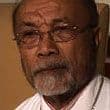
Interviews with Alberto Ricardo Da Silva
East Timor · Interviewed January 8, 2010
The Pope Comes to Timor
Recalls the reactions of the Timorese people and of the Indonesian government when Pope John Paul II said Mass in Tetum, the indigenous language of East Timor.
Transcript
Because the Holy Father was supposed to visit Indonesia, and not to visit Timor; and at that time the situation in Timor was bad, and the territory of Timor already belonged to Indonesia. Yet the Holy Father came to visit Timor as if it is not part of Indonesia, but at the same time his attitude towards the case of Timor is not to be revealed by this act – it was very difficult! However, with the assistance from everyone: from the people and also the Government of Indonesia, we managed to pull everything off. It was difficult! We had to do a lot of difficult diplomacies, but we managed to complete all the preparations to receive him in Taci Tolu.
And the Holy Father came. Pope John Paul II came. It was a success. Why a success? Because when the Holy Father came, hundreds and hundreds of people also came to Taci Tolu. This showed that the people were not afraid to come down to Dili, even though the Indonesians closed the way. This showed clearly, and confirmed, that the people were indeed determined! They might be killed, they might die, they might face various dangers, because the Indonesian military were fully armed and prepared for war, and yet, when the Holy Father came, the people greeted him as if there were no war in their midst. They had no fear! Women, men, young and old were not afraid to show up and all turned up in Taci Tolu. The sun was scorching. This showed – and everyone could see – that this people really wanted independence. That was what gave strength to the Church, for the Church to give a hand and help the people. Not for political reasons, but to ensure that the people are respected and considered by their fellow men, for their life and their human dignity.
That was how, for the first time, well, we were very scared because it was a big ceremony, and the Holy Father was going to preside at the Mass and people had thought that he was going to say the Mass in Latin, or in the Indonesian language, and suddenly the Holy Father solemnly commenced the prayers with Tetum “Hodi Padre, Hodi…” (In the Name of the Father, and of the…). Everyone was surprised! We, the priests had already prepared a prayer book specifically for him, but we did not reveal it to anyone! And we had thought that when he came to Timor, the Holy Father did not bring that book with him. But everyone… but he had been preparing himself since Rome, so when he came to Timor, he read, and he read it so beautifully! He said the entire Mass in Tetum!
And of course, the Indonesians did not like what happened! But for the sake of diplomacy the Indonesian authorities did not create any problems, but of course they did not like what had happened, because there was something abnormal in this: the Holy Father came to visit an Indonesian territory, yet he said Mass in Tetum not in Indonesian according to the authority of the Church. But the whole event turned out very, very beautifully!
As for the people, when the Mass concluded, the people dispersed, they all ran away… but the image that was clearly painted was this, and everyone could see, from the international point of view was this, that this people was indeed determined! And this was what the Church worked for. Not to create a special moment, but to uphold the dignity of the persons, their worth as humans, and their aspirations, desires. And whenever there was a need to speak up to the authorities, when permitted to do so, the Church spoke out to the authorities, and spoke about the people’s desire for self-determination. But this was done with enormous diplomacy, because it was a very dangerous thing to do. This is to explain the role of the Church in Timor. At that time, I was already the Vicar General, which meant that I did not just look after Motael parish, but also travelled to various areas in the country. This afforded me the obligation to really know the situation of the people.
About Alberto Ricardo Da Silva
Bishop Alberto Ricardo Da Silva (1943 – 2015) was the Roman Catholic bishop of Dili, the capital of East Timor. In 1991, he was a parish priest who gave sanctuary to student activists who were threatened by the Indonesian military because of their support for Timorese independence. In November of that same year, his church was surrounded by the military-organized mobs, and one of the student activists inside the church, Sebastião Gomes, was taken out and shot to death.
On November 12, 1991, Father Da Silva said a funeral mass for Gomes. The funeral procession from the church to Santa Cruz Cemetery turned into a peaceful protest demonstration, with several thousand men, women, and children waving banners and chanting pro-independence slogans. After the procession had entered the cemetery, the military opened fire, killing an estimated 250 mourners, including children in their Catholic school uniforms. A videotape of the attack was smuggled out of the country, and the Santa Cruz massacre focused the world’s attention on East Timor, substantially increasing pressure on the Indonesian government to respect the Timorese people’s right to self-determination.
In the weeks after the massacre, Father Da Silva was subjected to repeated harsh interrogations by the military authorities. He was accused of being the “mastermind” of the demonstrations, although he insisted that he was interested only in his religious ministry, not in politics, and that this ministry had included Timorese of all political persuasions as well as Catholic members of the Indonesian military. Nevertheless, he was repeatedly threatened with imprisonment or worse. In order to get him out of harm’s way, his church superiors assigned him to study in Rome. He returned to Timor after several years and Pope John Paul II named him as Bishop of Dili in 2004. As bishop, Da Silva pressed for justice for the victims of violence during East Timor’s occupation and struggle for independence. He also encouraged the Timorese people to take part in their country’s democratic development.
He resigned as bishop shortly before his death in April 2015.