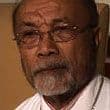
Interviews with Alberto Ricardo Da Silva
East Timor · Interviewed January 8, 2010
Human Dignity
His efforts as a priest in occupied East Timor to minister to the spiritual needs of Timorese parishioners and Indonesian soldiers, while insisting on respect for the dignity of each human being.
Transcript
When the Indonesians had settled down in Timor, my obligation as a priest dictated that I must also attend to the needs of the Indonesian population in Timor, because some of them were Catholics.
All these situations taught me a lot of lessons. They knew that in my duties as a priest, my mission was to tend to the spiritual matters such as the liturgy, catechism, bringing souls to God; those were part of my duties. Correct. However, in carrying out my priestly duties, I also sought out the occupying forces, that is, the Indonesians at that time, because my preoccupations were this: the people and their relationship with the authorities, the Indonesians, everywhere.
So I also tried to explain that my mission was spiritual, pastoral work, evangelization. However, it is also necessary for the occupying forces to respect the value of the human person, the dignity of the human person, the rights of the people, the life of the people. I sought to state that whoever it is, whatever their identity, whatever authorities in this world, must pay attention to, must uphold these values: respect people’s lives, respect people’s dignity as human beings. This is a must.
It was difficult, but there were also Catholics among them. I sought to have good relationships with non-governmental organizations so that I could communicate these aspirations to them. But I was not alone. I then met my colleague priests. By then we had begun to meet and talk with each other. Before that we were scattered. And we found out that our ideas, observations, understanding were relatively the same regarding the actual situation of the people and the Indonesian occupation.
We saw that everyone was suffering, there were great economic difficulties at that time. As priests, as pillars of the Church, we were expected to make sacrifices, work together and sought ways to help each other and the people. And that was how we began to develop, create our liturgy in Tetum, because one of the main principles held by the occupying forces is the preservation of the Unity of Indonesia; meaning, although Indonesia is made up of various groups, their political principles were one and the whole nation spoke one language: Bahasa Indonesia. Therefore, we the priests, made our reflections, not a lot but a little bit, we made our reflections and decided that we had to do something about this.
Because if we, at that time, guided all our people to enter into and follow the methods and strategies of Indonesia, for everyone to use only one language, then automatically the liturgy, and I said the liturgy because the majority of the population of Timor were Catholics, then, in order to carry out our cults, our teachings, our prayers, etc, it would have to be done in the Indonesian language, and if that was the case then we would lose our identity as a people.
We were thinking about the future. So the Timorese group worked day and night to create the liturgy in Tetum and not in Indonesian. It was difficult, we did not have many means to do so, but we managed to get approval from the Vatican to use Tetum as a unifying language for the people. It was difficult because the Indonesian Government did not permit us, but we kept going forward and there were not too many difficulties, until the Vatican gave us the approval for Tetum as the official language to be used in the Liturgical celebrations.
So my work in Becora was basically the same, in defending the lives of the people. All the priests of Timor at that time had to do the same thing. Defend against violence, those who were victims of injustices. The Church carries our activities to tend to the spiritual lives of the people, but She also relates Her work to the value and the dignity of the human person and sought to defend the lives of the people.
Whenever there were cases of someone who was going to be killed, we the church officials intervened, and sought to save that life. There were many cases, but the location was far and there were no transportation so we could not save everyone but this is just to illustrate about the kind of work that we did at that time.
With regard to the idea that Timor must become independent, in my observation, it became firmer and firmer by the days. With regard to the unity of the people, starting from the little children to the youths, it seemed to me that they were unified, and were all aiming for one positive end, which was self-determination.
And so in our work as priests, in the field, we taught in schools, although it was difficult, because of the situation of war, in our work in defending lives, defending little people, sick people, defenseless people who might suffer injustices, we held firm to truth and justice. These are the principles of the Church, to help the people, to save them from their situation and alleviate their suffering, but we did it in such a way without eliminating the aspirations of the people. And their aspiration was for self-determination.
About Alberto Ricardo Da Silva
Bishop Alberto Ricardo Da Silva (1943 – 2015) was the Roman Catholic bishop of Dili, the capital of East Timor. In 1991, he was a parish priest who gave sanctuary to student activists who were threatened by the Indonesian military because of their support for Timorese independence. In November of that same year, his church was surrounded by the military-organized mobs, and one of the student activists inside the church, Sebastião Gomes, was taken out and shot to death.
On November 12, 1991, Father Da Silva said a funeral mass for Gomes. The funeral procession from the church to Santa Cruz Cemetery turned into a peaceful protest demonstration, with several thousand men, women, and children waving banners and chanting pro-independence slogans. After the procession had entered the cemetery, the military opened fire, killing an estimated 250 mourners, including children in their Catholic school uniforms. A videotape of the attack was smuggled out of the country, and the Santa Cruz massacre focused the world’s attention on East Timor, substantially increasing pressure on the Indonesian government to respect the Timorese people’s right to self-determination.
In the weeks after the massacre, Father Da Silva was subjected to repeated harsh interrogations by the military authorities. He was accused of being the “mastermind” of the demonstrations, although he insisted that he was interested only in his religious ministry, not in politics, and that this ministry had included Timorese of all political persuasions as well as Catholic members of the Indonesian military. Nevertheless, he was repeatedly threatened with imprisonment or worse. In order to get him out of harm’s way, his church superiors assigned him to study in Rome. He returned to Timor after several years and Pope John Paul II named him as Bishop of Dili in 2004. As bishop, Da Silva pressed for justice for the victims of violence during East Timor’s occupation and struggle for independence. He also encouraged the Timorese people to take part in their country’s democratic development.
He resigned as bishop shortly before his death in April 2015.