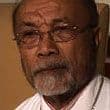
Interviews with Alberto Ricardo Da Silva
East Timor · Interviewed January 8, 2010
Journey of Faith
The closer I got to the people, the more I understood that they had a desire inside of them. . . . They wanted self-determination.
Transcript
I studied to become a priest in Macau. I studied philosophy. However, I was not able to complete my studies, due to the problem of Mao Tse Tung and the difficulties of that time. We had to study outside, continue our studies overseas, and so I went to Portugal to study.
I studied there for five more years, and I completed my ecclesiastical studies in philosophy, theology, and other subjects, for the Priesthood. And I was ordained as a priest in 1972. I then returned to Timor and immediately began to work as a Priest.
Since those early times, according to my knowledge, my view, through my talks and questioning of the people – I had great interest in the people of Timor and the problems of Timor. Many of my fellow priests did the same thing, because they were Timorese.
My work as a pastor began in Ossu in the Eastern Part of the country. I then moved to work in Dili, in Dare. It was then that the problems of war started. The war started and on April, 25 Portugal gave the possibility to all of, what were then referred to as its “overseas provinces” to choose their own future. At that time, it was a big problem in Timor.
Political parties began to emerge in Timor, and there existed disorder and chaos. There were no mutual understanding among Timorese and there were violence. I stood with the people during those very difficult situations, until the Indonesians came in. When the Indonesians came in, I remained in my position. I am saying this, because at that time, hundreds and hundreds of the population of Dili ran to the mountains to find shelter, to find a place to protect themselves from the great violence that were taking place in Dili.
Mortars, mortar pieces were shot everywhere, and many people died. Many residents of Dili ran up to Dare and stayed with me there because they were not able to continue to the mountains. So I began to become aware of the various problems that the people faced, and of their insecurities. It is not the first time that the Timorese population faced problems, but by then the problems and insecurity had escalated enormously.
I saw that the people were looking for protection; I saw that that was why they sought to stay with me in Dare. I had the opportunity to get away; I could have gone to Australia, I could have gone to Indonesia or to Portugal as others did. I, too, had the opportunity to get out, but my conscience did not allow me to do so.
Because many people had run to Dare to stay with me, children, women and men, hundreds of them became refugees and went there. So my conscience did not allow me to get away, but instead, it dictated me to receive them, to assist them, and carry out my duty as a priest, giving spiritual support; evangelization, apostolate, religious instructions – I had to assist and respond to the needs of the people.
And I saw, the closer I get to the people, the more I became aware that they had a desire inside of them, which was essential. They wanted self-determination. They faced so much violence, confronted various suffering… because as a matter of fact, during those times, as part of the military strategy, an Indonesian military battalion even came to stay with me and the population in Dare so the situation was very complicated; you see, the population were afraid, but unable to run further away from Dare and so they stayed with me because they felt protected by me, but then an Indonesian battalion came and joined us, too, in Dare. So I had to maintain good relationships with both the Indonesian military and Timorese population who had sought refuge with me. That was difficult. However, that taught me many things.
And I had a deep conviction, I believed that these people who had gone through difficult and violent times during the civil wars, when the Timorese were divided among themselves, did not understand each other and were killing each other; I saw that these same people had become united, and were now looking for ways to achieve independence.
That was my feeling, because I spoke to people, and I saw their attitudes which spoke of this. So I took it upon myself, to look for ways to explain to the Indonesians with whom I maintained good relationships, that this people has a good desire in their hearts, they desired something good, they did not want something bad; they wanted to become a independent nation. I explained this with utmost care and caution. I had to do that because I felt it was important to make the Indonesians understand why the Timorese are fighting/resisting their presence.
About Alberto Ricardo Da Silva
Bishop Alberto Ricardo Da Silva (1943 – 2015) was the Roman Catholic bishop of Dili, the capital of East Timor. In 1991, he was a parish priest who gave sanctuary to student activists who were threatened by the Indonesian military because of their support for Timorese independence. In November of that same year, his church was surrounded by the military-organized mobs, and one of the student activists inside the church, Sebastião Gomes, was taken out and shot to death.
On November 12, 1991, Father Da Silva said a funeral mass for Gomes. The funeral procession from the church to Santa Cruz Cemetery turned into a peaceful protest demonstration, with several thousand men, women, and children waving banners and chanting pro-independence slogans. After the procession had entered the cemetery, the military opened fire, killing an estimated 250 mourners, including children in their Catholic school uniforms. A videotape of the attack was smuggled out of the country, and the Santa Cruz massacre focused the world’s attention on East Timor, substantially increasing pressure on the Indonesian government to respect the Timorese people’s right to self-determination.
In the weeks after the massacre, Father Da Silva was subjected to repeated harsh interrogations by the military authorities. He was accused of being the “mastermind” of the demonstrations, although he insisted that he was interested only in his religious ministry, not in politics, and that this ministry had included Timorese of all political persuasions as well as Catholic members of the Indonesian military. Nevertheless, he was repeatedly threatened with imprisonment or worse. In order to get him out of harm’s way, his church superiors assigned him to study in Rome. He returned to Timor after several years and Pope John Paul II named him as Bishop of Dili in 2004. As bishop, Da Silva pressed for justice for the victims of violence during East Timor’s occupation and struggle for independence. He also encouraged the Timorese people to take part in their country’s democratic development.
He resigned as bishop shortly before his death in April 2015.