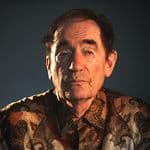
Interviews with Albie Sachs
South Africa
Treatment in Prison
“He pries my eyes open and puts me back on the chair.”
Transcript
Two years later I’m picked-up again. I won’t go through all the details, but this time I’m given sleep deprivation with a team of six it turns out, two on for 40-50 minutes, banging, shouting, making a noise and then total silence and then bang, bang, bang, bang, noise and then total silence.
They leave and another two come in and it goes on through the afternoon, through the night. I’m given something to eat and I detect with my cross-examiners, intuitions if you like from my days in court, there’s a kind of a smirk on their face and I’m fairly sure there was something in the food. Overwhelming feeling of fatigue and my body is fighting my mind and my will.
Eventually in the early hours of the morning I collapse onto the floor and there are feet around me, black shoes, white shoes, water is poured onto me. I’m lifted up. A really famous interrogator named Swanepoel, S-W-A-N-E-P-O-E-L, Swanepoel is in charge and he lifts me up and he’s got thick, heavy fingers and he pries my eyes open and puts me back on the chair. I topple down again, it happens a few times. Eventually I’m sitting there and I know I’m breaking down and I try to control my breakdown.
[Theunis Swanepoel (1928 – 1998) was one of the South African apartheid government’s most notorious interrogators.]
About Albie Sachs
Albie Sachs was born on January 30, 1935 in South Africa and grew up under the apartheid government.
His career as a freedom and human rights activist started at seventeen, when as a second-year law student at the University of Cape Town, he became active in nonviolent, anti-apartheid protests. At 21, he began practicing law and was known for defending individuals charged under racial statutes and repressive security laws. Sachs himself was arrested by the security police, subjected to banning orders restricting his movement, and eventually placed in solitary confinement without trial for extended periods of time.
In 1966, he went into exile. After spending eleven years studying and teaching law in England, Sachs worked in Mozambique as law professor and legal researcher. In 1988, he survived a car bomb, but lost an arm and sight in one eye.
During the 1980s, working closely with Oliver Tambo, leader of the African National Congress (ANC) in exile, Sachs helped draft the organization’s Code of Conduct, as well as its statutes. After recovering from the bombing, he devoted himself full-time to preparations for a new democratic, South African constitution. In 1990, he returned home to South Africa and as a member of the Constitutional Committee and the National Executive of the ANC, took an active part in the negotiations leading to South Africa’s democratic transition. After the first democratic election in 1994, Sachs was appointed by President Nelson Mandela to serve on the newly established Constitutional Court, where he served until 2009.
Sachs has travelled to many countries sharing South Africa’s experience and discussing human rights.