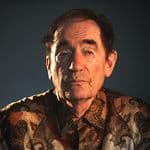
Interviews with Albie Sachs
South Africa
Background
Albie Sachs introduces himself.
Transcript
I didn’t stand a chance as you Americans would say, I didn’t stand a chance. Even my name Albert Sachs, people call me “Albie Sachs.” I was named after an African trade union leader who died shortly before I was born in 1935.
Everything about me from the moment of my birth in a sense destined me to end up in the freedom struggle in South Africa. My parents had split up. Both had come as young children from Lithuania, fleeing the pogroms aimed at Jews there and come to South Africa; grown up here with the benefits of having a white skin that came automatically with people who are classified as “whites.”
But from a community that had known oppression and that dreamt of a world in which people would be free and that was the atmosphere in which I grew up. My dad was a trade union leader. He was General Secretary of the garment workers’ union, living in Johannesburg. He and my mom separated when I was very, very young.
She worked for Moses Kotane, an African leader who was one of the top African National Congress leaders and also General Secretary of the Communist Party.
[Moses Kotane (1905 – 1978) was a South African anti-apartheid activist. The African National Congress (ANC) is a political party that served as the most prominent resistance movement against South Africa’s apartheid system, at times resorting to violence through its military wing, Umkhonto we Sizwe. It was officially banned by the South African government from 1960 to 1990. As apartheid collapsed, the ANC’s leader, Nelson Mandela, was elected President of South Africa in 1994 and established a democratic government.]
So my very first memories are of my mom saying, “Tidy up, tidy up, Uncle Moses is coming,” and Uncle Moses was Moses Kotane, not Moses “Cohen”, but Moses Kotane, and it seemed absolutely natural. She respected him as her employer, as a political leader.
That was a real world for me as a young white child growing up in South Africa. In our small space of our home and our daily life and her friends and the things that were important to her, everything revolved around the idea of a nonracial, free, and democratic society.
About Albie Sachs
Albie Sachs was born on January 30, 1935 in South Africa and grew up under the apartheid government.
His career as a freedom and human rights activist started at seventeen, when as a second-year law student at the University of Cape Town, he became active in nonviolent, anti-apartheid protests. At 21, he began practicing law and was known for defending individuals charged under racial statutes and repressive security laws. Sachs himself was arrested by the security police, subjected to banning orders restricting his movement, and eventually placed in solitary confinement without trial for extended periods of time.
In 1966, he went into exile. After spending eleven years studying and teaching law in England, Sachs worked in Mozambique as law professor and legal researcher. In 1988, he survived a car bomb, but lost an arm and sight in one eye.
During the 1980s, working closely with Oliver Tambo, leader of the African National Congress (ANC) in exile, Sachs helped draft the organization’s Code of Conduct, as well as its statutes. After recovering from the bombing, he devoted himself full-time to preparations for a new democratic, South African constitution. In 1990, he returned home to South Africa and as a member of the Constitutional Committee and the National Executive of the ANC, took an active part in the negotiations leading to South Africa’s democratic transition. After the first democratic election in 1994, Sachs was appointed by President Nelson Mandela to serve on the newly established Constitutional Court, where he served until 2009.
Sachs has travelled to many countries sharing South Africa’s experience and discussing human rights.