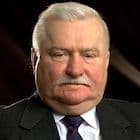
Interviews with Lech Walesa
Poland
Winning the Development Battle
“You have just driven the last nails into the coffin of Communism.”
Transcript
When their [Poland’s Communist regime] law and order people came for me [during Poland’s period of martial law from 1981 – 1983], I said to them, and this is a matter of public record, I said I was the winner here, and you guys are the losers – that you have just driven the last nails into the coffin of Communism. And up to this point everything I said was correct, but then I wound up going one-half sentence too far. I said, you will be coming back on your knees and begging me to help you out of this bind. So there I was carrying it too far.
I was completely convinced of it; to this day I marvel at the absolute confidence of victory I had – utterly certain that it was going to happen. Because I guess I was looking at things not from a theoretical standpoint, but from a practical one. You know that civilization – the Internet – well, perhaps not the Internet yet, but satellite television at the time – that all these novelties were advancing so quickly that Communism was losing the battle of development – that Communism would have had to engage more and more resources into repression and guarding things.
Like when satellite television was coming in, they would have practically had to introduce a policeman in every building to make sure you tuned in to the right channels. Or that when cell phones were coming in, that we would not dial-up whoever were the “forces” they did not want you to talk with. And in this way, it was a struggle against development, against technology and this had a bearing on the fact that Communism at the time was moving at one-tenth the pace of capitalism. So as a result it had no chance, it was already a loser, but the problem then was, “How do you exit?”, “How do you not have bloodshed?”, “How do you win against them?”, and this was something for me to mull over.
And it was the only thing to think about, not that they might win. They could not win, and the fact is, had they chosen to go along with these advances, they would have lost anyway. So Communism in that time was beaten one way or the other, because technology would not have let it prevail. It had to because it did not square with technological advancement; it does not square with satellite television; it does not square with cellphones; it does not square with the Internet. Because it slows things down, it bogs down, and it lies and then all that means that it was wrong for the times.
At a certain time in the past, when machinery was being introduced, for instance, capitalism started growing. All these manufacturing plants, all these capitalists were misbehaving. For a certain time it was a justifiable [idea]. Because of all the wrongdoing, because of the injustice, because the whole game then was so egregiously wrong that people had to stand up for themselves.
So at a certain stage of development Communism was justifiable, but then the communists wrote in their slogans that they would introduce order and justice, but they were just slogans. And in reality they introduced no such thing. As an example, they appropriated charity, yet they were never charitable because they did not have the resources to be charitable since they were so unproductive.
About Lech Walesa
Lech Walesa was born on September 29, 1943, in Popowo, Poland. After primary and vocational education, he pursued a career as an electrician and was employed at the Lenin Shipyard in Gdansk, on the Baltic coast of Poland. As a shipyard worker, he became increasingly active in labor matters and committed himself to promoting workers’ rights. In the 1970s, he became a leader of the effort to establish independent trade unions, which were forbidden in communist Poland. Walesa organized shipyard workers, distributed underground leaflets, and educated workers on their rights.
Walesa was a principal organizer of the Lenin Shipyard Strike in August 1980 and as spokesman for the workers, he quickly became the public face of the independent labor movement. His tenacious negotiations with communist authorities and steadfast support of workers’ rights inspired Poles and resulted in the establishment of the Solidarity trade union, the first independent labor union in the communist world. Solidarity soon expanded its reach beyond labor issues and became the hub for the country’s dissident activity, uniting democratic forces across Poland.
The communist regime attempted to crush Solidarity’s influence and popularity by declaring martial law on December 13, 1981. As the movement’s leader, Walesa was among the first to be arrested and imprisoned. During this time, Poland’s communist government banned Solidarity, but Walesa wouldn’t surrender. He remained a symbol and spokesman for the ideals embodied by Solidarity as the movement continued its activities underground. Walesa’s struggle was recognized by the international community when he was awarded the Nobel Peace Prize in 1983.
As popular dissatisfaction grew against the regime in the late 1980s, Walesa led negotiations with the government to ease tensions. The negotiations resulted in elections on June 4, 1989, that saw the establishment of the first non-communist government within the Warsaw Pact. With the acquiescence of the Soviet Union and inspired by the moral leadership of the Polish Pope, John Paul II, Poland began its transformation to democracy and free markets.
On December 22, 1990, Lech Walesa became the first democratically elected president of Poland. While in office, Walesa was a driving force in Poland’s European integration, laying the groundwork for Poland’s accession to the North Atlantic Treaty Organization and the European Union. After leaving office in 1995, he founded The Lech Walesa Institute, an organization committed to supporting democracy throughout the world.