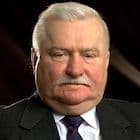
Interviews with Lech Walesa
Poland
A Polish Pope
“So in this state of powerlessness, the state of despair, a Polish man becomes pope.”
Transcript
The communists had a simple philosophy about this – do not let them get organized. If they try to mount a struggle, destroy those attempts at struggle and then mock them saying, “You know, what kind of opposition are they?”, “What kind of a struggle is this?”, “What kind of a fight, what kind of a demonstration?” And themselves – to mount counterdemonstrations. This was a method by which they caused a situation of despair. We did not believe that there was a chance of victory. And then also, very quietly they were pointing out to us, “Hey, can’t you see that there are over 200,000 Soviet troops stationed in Poland?”, “Can’t you see that there are over a million Soviet soldiers stationed all around Poland?”, “Can you not see that under these circumstances there is no chance of toppling Communism here?”
So this caused that state of apathy, you know that in Poland, but really throughout the world, people did not believe that there was even a chance of breaking out from Communism. And so in this state of powerlessness, the state of despair, a Polish man becomes pope [Karol Wojtyla, Cardinal and Archbishop of Krakow, led the Roman Catholic Church as Pope John Paul II from 1978 to 2005]. One year after being elected, he arrives in Poland, and the entire world starts paying attention to Poland, to what is happening in this communist country where practically the whole nation would participate in these meetings with the Holy Father in various locations — even the political police, even the communists participated in these meetings.
The Holy Father had assembled us for prayer, but in the course of praying together we noticed that there were so many of us. So this is how the Holy Father had awakened us and how the vestigial opposition organizations were able to lead this awakened nation to victory. So without the Holy Father there, we would not have been able to take note of our numbers and to organize, and the Communists would have been able to break us apart. So this was caused by coming together for prayer, yes, but it also helped us to count our strength in numbers, to gain heart, and to have those vestigial organized opponents of the regime to lead us on and into battle.
So on the one hand let us not exaggerate the Holy Father´s role, but by the same token, let us not diminish it either. The Holy Father was not someone who fought against Communism, this was not his role, but without him we would not have organized, without him we would not have become the power we became. And as proof for my point you have the fact that in Cuba the Holy Father raised their spirits even more, but there was not an organization which could have shouldered leadership of this awakened Cuban nation, and that that is why there is still a functional communist regime there today.
About Lech Walesa
Lech Walesa was born on September 29, 1943, in Popowo, Poland. After primary and vocational education, he pursued a career as an electrician and was employed at the Lenin Shipyard in Gdansk, on the Baltic coast of Poland. As a shipyard worker, he became increasingly active in labor matters and committed himself to promoting workers’ rights. In the 1970s, he became a leader of the effort to establish independent trade unions, which were forbidden in communist Poland. Walesa organized shipyard workers, distributed underground leaflets, and educated workers on their rights.
Walesa was a principal organizer of the Lenin Shipyard Strike in August 1980 and as spokesman for the workers, he quickly became the public face of the independent labor movement. His tenacious negotiations with communist authorities and steadfast support of workers’ rights inspired Poles and resulted in the establishment of the Solidarity trade union, the first independent labor union in the communist world. Solidarity soon expanded its reach beyond labor issues and became the hub for the country’s dissident activity, uniting democratic forces across Poland.
The communist regime attempted to crush Solidarity’s influence and popularity by declaring martial law on December 13, 1981. As the movement’s leader, Walesa was among the first to be arrested and imprisoned. During this time, Poland’s communist government banned Solidarity, but Walesa wouldn’t surrender. He remained a symbol and spokesman for the ideals embodied by Solidarity as the movement continued its activities underground. Walesa’s struggle was recognized by the international community when he was awarded the Nobel Peace Prize in 1983.
As popular dissatisfaction grew against the regime in the late 1980s, Walesa led negotiations with the government to ease tensions. The negotiations resulted in elections on June 4, 1989, that saw the establishment of the first non-communist government within the Warsaw Pact. With the acquiescence of the Soviet Union and inspired by the moral leadership of the Polish Pope, John Paul II, Poland began its transformation to democracy and free markets.
On December 22, 1990, Lech Walesa became the first democratically elected president of Poland. While in office, Walesa was a driving force in Poland’s European integration, laying the groundwork for Poland’s accession to the North Atlantic Treaty Organization and the European Union. After leaving office in 1995, he founded The Lech Walesa Institute, an organization committed to supporting democracy throughout the world.