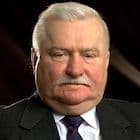
Interviews with Lech Walesa
Poland
International Support
“If you cannot lift a load by yourself, then go ask others who will help you lift it.”
Transcript
The simplest way to put it is this: if you cannot lift a load by yourself, then go ask some others who will help you lift it. There are various burdens or loads: they can be local, they can be national, European or even global. And so for each of these loads or difficulties you need to match willing assistants that will help you lift them. Communism was difficult to fight against because this was, as I said before, a great military and nuclear power, and so such assistance was absolutely crucial, because we would not have been able to shoulder that burden which Communism was. Of course, it does have that obligation, yes, but then you have to frame this obligation against the times in which we live, places that we inhabit.
We so often forget what democracy is. Democracy itself is made up of three components: one-third of democracy is the laws and constitutions which allow or do not allow taking action of various sorts; the next third is whether a given society uses those rights, engages, forms political parties, takes the trouble to vote; and the last third, in this frame of reference, is a checkbook of sorts, but conceived on a mass scale – the wealth of a society, whether that society is able to defend itself, to not be afraid about employment, and many items such as that. This is the Lech Walesa formula for democracy, and you can use this formula anywhere to find out what the condition of a given democracy is. You know, for any given moment and each place it would be slightly different.
The times we live in are highly normalized – we have pluralism, democracy, the free market. And each country that has these dimensions, and the better they are, the more it is able to fit itself into these puzzles, in their varieties and types. Anyone who does not have these dimensions, a country that does not really fit in will be marginalized, but again, all these processes, they cannot be implemented overnight. Belarus, for instance, is highly dependent on Russia, you know, for their electricity, their gas and their fuels and so it is really not able to stand up for itself because all you have to do is turn off that tap and you don’t really have to fight them very hard.
They will come back on their knees and beg you to open that tap again. And so if Europe, or the world, intends to help Belarus, then they have to prepare, to set up all those other strategic things, and then say, well, if Russia acts one way or another then the electricity will stay on by another means, and Belarus will be able to manage. Now with Cuba it is a bit of a different story. You could hook up Cuba somewhat faster to the West – but, well, there you have it: Democracies as highly developed as the United States do not really engage, do not really apply pressure, and I don’t know, perhaps don’t really want Cuba to join up with them all that soon.
So therefore you have to see the process, or even the struggle, in Cuba differently from the possibilities and opportunities open to Belarus, as an example.
About Lech Walesa
Lech Walesa was born on September 29, 1943, in Popowo, Poland. After primary and vocational education, he pursued a career as an electrician and was employed at the Lenin Shipyard in Gdansk, on the Baltic coast of Poland. As a shipyard worker, he became increasingly active in labor matters and committed himself to promoting workers’ rights. In the 1970s, he became a leader of the effort to establish independent trade unions, which were forbidden in communist Poland. Walesa organized shipyard workers, distributed underground leaflets, and educated workers on their rights.
Walesa was a principal organizer of the Lenin Shipyard Strike in August 1980 and as spokesman for the workers, he quickly became the public face of the independent labor movement. His tenacious negotiations with communist authorities and steadfast support of workers’ rights inspired Poles and resulted in the establishment of the Solidarity trade union, the first independent labor union in the communist world. Solidarity soon expanded its reach beyond labor issues and became the hub for the country’s dissident activity, uniting democratic forces across Poland.
The communist regime attempted to crush Solidarity’s influence and popularity by declaring martial law on December 13, 1981. As the movement’s leader, Walesa was among the first to be arrested and imprisoned. During this time, Poland’s communist government banned Solidarity, but Walesa wouldn’t surrender. He remained a symbol and spokesman for the ideals embodied by Solidarity as the movement continued its activities underground. Walesa’s struggle was recognized by the international community when he was awarded the Nobel Peace Prize in 1983.
As popular dissatisfaction grew against the regime in the late 1980s, Walesa led negotiations with the government to ease tensions. The negotiations resulted in elections on June 4, 1989, that saw the establishment of the first non-communist government within the Warsaw Pact. With the acquiescence of the Soviet Union and inspired by the moral leadership of the Polish Pope, John Paul II, Poland began its transformation to democracy and free markets.
On December 22, 1990, Lech Walesa became the first democratically elected president of Poland. While in office, Walesa was a driving force in Poland’s European integration, laying the groundwork for Poland’s accession to the North Atlantic Treaty Organization and the European Union. After leaving office in 1995, he founded The Lech Walesa Institute, an organization committed to supporting democracy throughout the world.