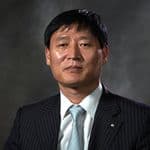
Interviews with Kim Kwang-jin
North Korea
Kim Jong Un
“He purged and killed his uncle.”
Transcript
If I were to point out major changes that occurred after Kim Jong Un came to power, number one is what I call replacing the previous generation. This is probably the most conspicuous thing because he purged and killed his uncle Jang Song Thaek.
[Kim Jong Un (1983 – ) assumed power in North Korea after his father’s death in 2011. Jang Song Thaek (1946 – 2013) was widely regarded as the second-most-powerful person in North Korea before being branded a traitor and executed by his nephew, Kim Jong Un.]
A second characteristic is that Kim Jong Un tends to be indecisive when it comes to implementing policy although, unlike his father Kim Jong Il who tended to be vague in his action, Kim Jong Un tends to be more reassured, firm and confident about what he wants.
[Kim Jong Il (1941 – 2011) succeeded his father, Kim Il Sung, and led North Korea from 1994 until his death in 2011.]
Kim Jong Un has yet to solidify his power. I say this because he constantly demotes and promotes military generals, which suggests he hasn’t established control over the military.
And ever since he executed Jang Song Thaek, Kim Jong Un is showing signs of wooing the military; he is paying numerous visits to the military and depending on them.
This suggests that he fears the military and once again has yet to establish tight control over it. Based on a survey that we conducted with recent defectors, we found that after Kim Jong Un took power, the North Korean people had high hopes for him but ever since Jang Song Thaek’s execution, they’ve been disappointed. So when it comes to winning public support he has yet to firmly gain hold.
About Kim Kwang-jin
In September 2003, Kim Kwang-jin and his family rushed to an airport in Southeast Asia to fly to freedom in Seoul, South Korea. Months earlier, Kim lived a privileged life working for the government’s overseas banking operations in Singapore. Then Kim fell out of favor after he was suspected of leaking information about the regime to foreign nationals. Before being summoned back to North Korea face severe punishment, Kim made the decision to defect with his family.
During his banking career, Kim helped earn millions of dollars for what he calls North Korea’s “Royal Court Economy,” i.e., the enterprises and often illegal schemes that financially supported the country’s totalitarian dictatorship.
Since defecting, Kim Kwang-jin helped expose the North Korean government’s underhanded financial practices. He has also become an advocate for North Korean freedom and human rights. Kim currently works at the Institute for National Security Strategy in Seoul and is a columnist for Radio Free Asia.