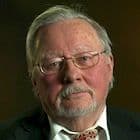
Interviews with Vytautas Landsbergis
Lithuania
The Goals of Sajudis
“Let’s ask the people how they wish to live.”
Transcript
Our fundamental goals were the same: liberty, freedom. How it could be considered by even activists of the movement or even among those Communist Party members who had been for reforms, for more freedoms. When some of them, or part of them wishing more freedoms, did not believe in the full freedom that is achievable. Anyway they were eager to fight or to win more freedoms, more autonomy, more gracious behavior of Kremlin allowing something more than before. But the same time, there were people of my type and our friends who always had in mind the ultimate goal is full freedom. Not limited, not part of freedom.
I had a chance sometimes to say it openly to Gorbachev or– and some opportunities that he– “If you are going to propose us some freedoms with the idea that we will be happy, it is not so. We wish whole freedoms which a normal nation deserves.” [Mikhail Gorbachev (1931 – ) served as the last General Secretary of the Communist Party of the Soviet Union from 1985 – 1991 and as President of the Soviet Union from 1988 until its dissolution in 1991.] To add to that we had also the old freedom fighters back from gulags, or those from underground spiritual activities, or those publishers and distributors of the free underground press, and the famous Lithuanian chronicles of the Lithuanian Catholic church, which have been distributed broadly and published in volumes in the West. And the K.G.B. could not stop it.
So this conspiracy in the– and the deep belief that the people are fighting for great and good — really was also strong. And they influenced our legalistic movement inside of Gorbachev’s reforms. Only with the correction that we always could say, and not only among ourselves but sometimes then publicly, that we want greater reforms than Gorbachev himself and we want unlimited reforms until the full freedom of choice is implemented. And freedom of choice was our goal with a little hesitation on what the people will choose. But first it was a principle. Let´s ask the people how they wish to live. Why you are playing a game being representatives of Lithuania? Who elected you? You are not elected by the people.
Let us have genuine free elections, competitive elections. And finally they agreed. The elections were the first achievement. And the next achievement was democracy. And democracy was our way to independence.
About Vytautas Landsbergis
Vytautas Landsbergis was born in Lithuania in 1932 to a family of noted intellectuals. During the Second World War, Lithuania was occupied by the Union of Soviet Socialist Republics (USSR), Nazi Germany, and once again by the USSR, which abolished Lithuania’s independence and forcibly annexed it. Landsbergis studied music and pursued a career as an educator, eventually becoming a professor of music history at the Lithuanian Academy of Music. He has written ten books on music and art history, five political books, and a book of poetry.
In 1988, Landsbergis joined other artists and intellectuals in forming the Sajudis movement, which developed to support the restoration of Lithuanian independence from the Soviet Union. He was elected as chairman of the movement. Under his leadership, Sajudis quickly won broad popular support from the Lithuanian population.
In February 1989, Sajudis declared the Soviet occupation illegal and formally proclaimed its goal of restoring independence. Landsbergis was elected as a deputy to the new USSR Congress of People’s Deputies in March 1989. Sajudis won 36 of the 42 seats at stake and used their mandates to lobby for Lithuanian independence.
On August 23, 1989, on the fiftieth anniversary of the Nazi-Soviet treaty that led to the abolition of the independence of Estonia, Latvia, and Lithuania and their forcible incorporation into the USSR, Landbergis and the leaders of Sajudis joined with their counterpart organizations, the Rahvarinne Popular Front of Estonia and the Popular Front of Latvia, in organizing the Baltic Way demonstration. Over one million people joined hands to form a 600 kilometer long human chain across the three countries. The nonviolent protest drew worldwide attention to the Baltic nations’ quest for freedom and independence.
In the first free Lithuanian elections held in February 1990, Landsbergis was elected to the legislature. When the new legislature convened in March, Landsbergis was elected chairman (speaker) and proclaimed the reestablishment of independence. In 1990 and 1991, he served as chairman of the commission that drafted the new Lithuanian constitution. He also chaired the Lithuanian delegation for negotiations with the USSR, achieving a withdrawal of Soviet military forces from Lithuania and securing widespread international recognition of the restored Lithuanian republic. In 1993, he cofounded the Lithuanian Conservative Party – Homeland Union and was elected party chairman.
From 1992 to 1996, he served as the leader of the opposition in the Seimas, the Lithuanian parliament. After his party won the 1996 elections, he served again as Chairman of the Seimas until 2000. He was an unsuccessful candidate for President in the 1997 elections.
In 2004, he was elected to the European Parliament as Lithuania joined the European Union. He was reelected in 2009.
Landsbergis has received numerous international honors for his artistic and political activities. In 2013, he received the Democracy Service Award from the National Endowment for Democracy’s for his efforts to build a stable democracy in Lithuania and to assist democratic development abroad.