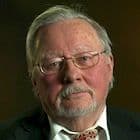
Interviews with Vytautas Landsbergis
Lithuania
Reversing Hitler and Stalin's Deal
How the Baltic States worked to restore their independence.
Transcript
It was a very important day — and the idea and implementation of such a manifestation. Until now it was the greatest manifestation in the world, in the longitude of 700 kilometers. And about one and a half million of people standing in a living chain and holding each other’s hands.[The “Baltic Way” was a peaceful demonstration organized on August 23, 1989, where an estimated 2 million people formed a human chain across Estonia, Latvia, and Lithuania to protest their countries’ subjugation to the Soviet Union.]
Sometimes it is not so clear today, because the approaches of cooperation even with evil, dictatorial regimes can be seen as travailing. We are maybe in the middle of the process. And the first of September of 1989, just after the Baltic Way manifestation, the chancellor, Helmut Kohl, [Helmut Kohl (1930 – ) is a German Christian Democratic politician. He served as chancellor from 1982 to 1998 and presided over the reunification of Germany in 1990.] spoke at the Bundestag [The German Parliament].
It was his famous speech, condemning the Teufelspakt made by Hitler and Stalin, not Molotov and Ribbentrop. [Teufelspakt is German for “devil’s pact,” referring to the Molotov-Ribbentrop Pact between the USSR and Nazi Germany that divided Central and Eastern Europe. Vyacheslav Molotov and Joachim von Ribbentrop were the Soviet and Nazi foreign ministers that negotiated the treaty. Adolf Hitler (1889 – 1945) led Germany’s Nazi regime between 1934 – 1945. Josef Stalin (1878 – 1953) was General Secretary of the Soviet Communist Party between 1922 and 1952.]
He said Hitler and Stalin, which caused the sufferings, losses in justice to so many nations, including [the] Baltic nations. He named then. And then he should be aware after the Baltic Way manifestation. So it could not pass unnoticed by the world. That it is not political activism of some groups, being for democracy and bringing problems for some plans or the established about the new world order promoted by Mr. Gorbachev, in which on a price of diminishing or ceasing of nuclear confrontation.
The Soviet Union would be assisted by its former enemy, the democratic West assisted. And accepted, approved in its borders, including all annexations, all occupations, all conquests of that longstanding continental colonial empire, because all conquerors of all the Russia, were on the same continent, spreading around. As czars used to say, “To every sea, to reach every sea and nations were for nothing.” So there were quite a lot of what we called illusionists in the Western political elite. Illusionists about Soviet Union, about a possible future of cooperation, accepting this empire in a more softer [form].
We should know to break through that cautiousness and limited mind about a real and possible democratic future for all the nations, not for themselves only. And it was maybe the historic overall of liberation movements in central Europe. But also in the Baltic states, because after the liberation of Poland and Czechoslovakia, and East Germany [was] even allowed to join with [West] Germany. And the process could stop on the borders of Soviet Union. And what about us? Then we had to stand up and to say, “Hey, gentlemen. It´s not all yet.” And this way, we served not all for ourselves only, but for all [the] nations of [the] Soviet Union.
The window was open. If Baltics may do it, go openly claiming that they are nations which want to be democratic nations in Europe, why not Ukraine? Why not the Caucasus? Why not Moldova?
About Vytautas Landsbergis
Vytautas Landsbergis was born in Lithuania in 1932 to a family of noted intellectuals. During the Second World War, Lithuania was occupied by the Union of Soviet Socialist Republics (USSR), Nazi Germany, and once again by the USSR, which abolished Lithuania’s independence and forcibly annexed it. Landsbergis studied music and pursued a career as an educator, eventually becoming a professor of music history at the Lithuanian Academy of Music. He has written ten books on music and art history, five political books, and a book of poetry.
In 1988, Landsbergis joined other artists and intellectuals in forming the Sajudis movement, which developed to support the restoration of Lithuanian independence from the Soviet Union. He was elected as chairman of the movement. Under his leadership, Sajudis quickly won broad popular support from the Lithuanian population.
In February 1989, Sajudis declared the Soviet occupation illegal and formally proclaimed its goal of restoring independence. Landsbergis was elected as a deputy to the new USSR Congress of People’s Deputies in March 1989. Sajudis won 36 of the 42 seats at stake and used their mandates to lobby for Lithuanian independence.
On August 23, 1989, on the fiftieth anniversary of the Nazi-Soviet treaty that led to the abolition of the independence of Estonia, Latvia, and Lithuania and their forcible incorporation into the USSR, Landbergis and the leaders of Sajudis joined with their counterpart organizations, the Rahvarinne Popular Front of Estonia and the Popular Front of Latvia, in organizing the Baltic Way demonstration. Over one million people joined hands to form a 600 kilometer long human chain across the three countries. The nonviolent protest drew worldwide attention to the Baltic nations’ quest for freedom and independence.
In the first free Lithuanian elections held in February 1990, Landsbergis was elected to the legislature. When the new legislature convened in March, Landsbergis was elected chairman (speaker) and proclaimed the reestablishment of independence. In 1990 and 1991, he served as chairman of the commission that drafted the new Lithuanian constitution. He also chaired the Lithuanian delegation for negotiations with the USSR, achieving a withdrawal of Soviet military forces from Lithuania and securing widespread international recognition of the restored Lithuanian republic. In 1993, he cofounded the Lithuanian Conservative Party – Homeland Union and was elected party chairman.
From 1992 to 1996, he served as the leader of the opposition in the Seimas, the Lithuanian parliament. After his party won the 1996 elections, he served again as Chairman of the Seimas until 2000. He was an unsuccessful candidate for President in the 1997 elections.
In 2004, he was elected to the European Parliament as Lithuania joined the European Union. He was reelected in 2009.
Landsbergis has received numerous international honors for his artistic and political activities. In 2013, he received the Democracy Service Award from the National Endowment for Democracy’s for his efforts to build a stable democracy in Lithuania and to assist democratic development abroad.