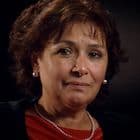
Interviews with Sihem Bensedrine
Tunisia
Targeting Her Family
It was for me the threat put on my children is the thing I suffered the most. Because you are supposed, as an adult, to protect your children.
Transcript
It was for me the threat put on my children is the thing I suffered the most. Because you are supposed, as an adult, to protect your children. And I and my husband were not able to do it. Fortunately, we have a big family. The family are very, very supportive. And sometimes, I didn´t have something to give them to eat. It was until this– this limit.
And my family and the family of my husband took my children and bring them and give them something to eat. Because we are prevented to have– during, as I told you, six year, no single income for my husband and for me. And nobody has the right to support us. Because they are punished. People– when we cross people on the street, they are afraid to say hello. Because if they say it, because we were surrounded on a daily basis, with a staff of policemen. And these policemen are not mainly for us. Because once, you are afraid, second time, a bit. Third time, you are used to see them. And your fear disappears.
But they were staying around us, in front of our house, in front of any place we go. And they are following us in a visible way. They are not hidden. And the aim the goal was to put us in quarantine. Anybody who can say hello, we will persecute him, he will be put in custody. They will beat him or her, until they understood– they understand we never have to say hello to such people.
And you are out of the society, out of the normal life. You are in quarantine. And for my children, it was very, very hard. Because you know, if you are a boy of 14 years or at the time, the second was ten years. And my girl was six, I guess. I don´t remember exactly.
And you are prevented to have friends. Your friends, when they come at home, their parents are beaten. They are persecuted because they are collaborating with a bad family. And then, after some years– after some months, not years, my children do not have any friend. And they are suffering from that. And they´re telling why we are not like the others. Why we are in such position?
And it´s a way to say you are not doing the right job to protect us. And that you do not have answer. You can´t say anything, because police are there. If you open the windows in the morning, you have the face of the policeman inside the window every day, every day. And they are, of course, they ring our phone when it is not cut at all. They are cutting our internet connection. They are preventing us to have any kind of communication with the others. Because they know what we are doing is collecting information, putting this information in an alert, and spreading out these alerts on the violation.
And we are not talking about us. We are talking about the other. Because what we suffered is something less than other opponents suffered from this regime. The Islamists were the main people who suffered from that. And they did something very, very bad. They rape their women. They harassed and persecuted children. They prevent some children to go to school. They are arresting in custody minors.
I think they are proud of Mommy and Papa. I think my children are proud of what we did because they know today that we contributed a little to this freedom we are benefitting from right now.
About Sihem Bensedrine
Sihem Bensedrine was born in 1950. She studied at the University of Toulouse Le Mirail in France, from which she holds a degree in philosophy. Upon her return to Tunisia in 1977, she began work as a journalist, and became known as a critic of the regime.
As one of the most prominent Tunisian human rights activists, she paid a high price for her views. The regime continually harassed her and her family, pressuring employers to fire her, applying financial pressure, and slandering her in the media. Bensedrine’s family was under constant surveillance, received death threats, and was at times not allowed to travel outside the country. Due to these threats, she spent years as an exile, continuing to speak out on human rights and democracy issues in her homeland.
In 1998, she cofounded the National Council for Liberties in Tunisia (CNLT). In 1999, she launched the “Kalima” website, which reported on conditions inside the country. Kalima later expanded to satellite radio broadcasting. She also cofounded the Observatory for Defense of Freedom of the Press, Publishing and Creation (OLPEC).
Bensidrine returned to Tunisia as the demonstrations against the Ben Ali regime gathered steam. She continues to advocate for freedom of the press and other human rights as Tunisia transitions to a new democratic system of government.