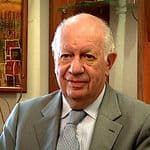
Interviews with Ricardo Lagos
Chile
The "No" Campaign
“It was very clear that now the only way to defeat Pinochet was through a plebiscite.”
Transcript
It was very clear that now the only way to defeat Pinochet was through a plebiscite.
[Augusto Pinochet was dictator of Chile between 1973 and 1990.]
And then the question was how to [get] prepared for that, how to register for that. Pinochet knew also that there were a few tricks. For instance: the decision was that [people had] to register (because all the electoral registries had been destroyed right after Pinochet took power) it was necessary again for every Chilean to register in the electoral vote [registry].
And then he [Pinochet] said: “this is voluntary.” Needless to say that everybody was going to register, [that is everybody] close to Pinochet in order to vote for Pinochet. So it was very difficult for us to convince those who were against Pinochet to go and register.
And the idea was very simple for us. We said: “well, let’s assume that the number of citizens above eighteen years old in Chile is eight million. Let’s assume that Pinochet has forty percent. That means 3.2 million. So if we are able to register more than 3.2 million, then we will win.”
And the idea was then to finally reach the point of seven million. Because if you have 3.2 and I have 3.6, then seven million is enough. And we celebrated the seven million registrations in Chile. And then the big question was to register, to register, to register.
Then the question was that you needed to be a legal political party in order to be able to have your own people to be entitled to be at the table to count the votes.
We had thirty five thousand voting places, voting tables, so we needed to prepare thirty five thousand citizens to be on behalf of the “No” campaign. [Chile’s “No” Campaign was designed by the country’s democratic opposition encouraging citizens to vote “no” against another term for President Augusto Pinochet in the 1988 nationwide plebiscite.
That required a lot of courage. To say, “I am against Pinochet and I am going to represent the No.”
Finally the discussion was: “Are we going to register one party or many political parties?” My decision was to have only one: the Party for Democracy. The problem was that the Christian Democrats wanted to register, the Radicals wanted to register, and they did. [The Party for Democracy (Partido por la Democracia or PPD) is a center-left political party in Chile.]
So at the end, the Party for Democracy became the party for independent people and members of the Socialist Party because the Socialist Party was forbidden according to Pinochet’s constitution.
About Ricardo Lagos
Ricardo Lagos served as president of Chile from 2000 to 2006. While in office Lagos was known for pursuing free-trade agreements, improving health care and education, and addressing the crimes of General Augusto Pinochet’s military regime.
Lagos was born in 1938 in Santiago, Chile. He earned a law degree from the University of Chile in 1960 and then attended Duke University, where he received a doctorate in economics in 1966. He returned to Chile and served as director of the University of Chile’s School of Political and Administrative Sciences and was subsequently appointed secretary general of the Latin American Faculty of Social Sciences.
Lagos was nominated by President Salvador Allende to be Chilean ambassador to the Soviet Union. But in 1973, Allende was overthrown in a military coup d’état led by Pinochet, and Lagos was never confirmed in that position.
Like many in the democratic opposition to the dictatorship, Lagos left Chile. While in exile in the United States and Argentina, he served at the United Nations as a consultant and economist at UNESCO and the International Labor Organization.
In 1978, he returned to Chile, where he became president of the Democratic Alliance, a coalition of parties opposed to Pinochet. In 1987, Lagos founded the Party for Democracy (Partido por la Democracia). During the historic 1988 national referendum to end the Pinochet dictatorship, Lagos was a key leader in the grassroots efforts to register voters and encourage them to vote against prolonging the military regime.
After democracy was restored, Lagos served as minister of education in the government of President Patricio Aylwin and as minister of public works under President Eduardo Frei before being elected president in his own right in January 2000.
Since leaving the presidency, Lagos founded the Fundación Democracia y Desarrollo (Foundation for Democracy and Development) in 2006 and currently serves as its president. He is also vice-chair of the Inter-American Dialogue and was UN special envoy for climate change from 2007 to 2010.
Twitter: @RicardoLagos