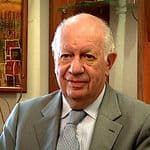
Interviews with Ricardo Lagos
Chile
Confronting Pinochet
“I will keep doing what I am doing because democracy will return and we will defeat you in the plebiscite”.
Transcript
That was a very funny story, a very funny discussion, because the Alianza Democrática was the first to understand that. Then there were some other institutions in civil society: the physicians, the lawyers, the teachers. Several of those associations had a very broad front, the civil front, the civil society. And in addition to that, there were some students’ movements plus the trade unions’ leaders.
[The Democratic Alliance of Chile (Spanish: Alianza Democrática de Chile) was a coalition of left-wing parties from 1942 to 1946, which succeeded to the Popular Front headed by Pedro Aguirre Cerda´s government (1938-1941).]
So you had labor movements and student movements. There was also another very important one: the women movement, Mujeres por la Vida, Women for Life.
In order to fight, in order to respect human life from the point of view of humans, you had several different instances plus some political institutions.
Now, it is true, it is much easier to say “no” and to agree to say “no” than to put together some program after the “no” succeeds. But that is another story.
Nevertheless, what I really think it was really important [was] the fact that we decided [to have] the “No” Campaign, and the fact that we decided that it was possible, with a paper and a pencil, to say “no” and that’s it… Because you only had two choices: yes or no. In the vote [ballot], yes or no. That’s it.
[Chile’s “No” Campaign was designed by the country’s democratic opposition encouraging citizens to vote “no” against another term for President Augusto Pinochet in the 1988 nation-wide plebiscite.]
And then the big issue was how you were going to register and how you were going to register the political parties. And I discovered… Once I was with President Alwyn in La Serena, it is a city about five hundred kilometers North of Santiago, and I received a… during those days you said a telex. Do you remember? There were no emails. [Patricio Aylwin Azócar (1918 – ) is a Chilean Christian Democrat politician, lawyer and former senator. He was the first president of Chile after democracy was restored in 1990.]
It was a telex. And the telex said: Arica [Region of Chile]. President Pinochet today said that there is somebody called Lagos. Be careful, Lagos, we are watching you.
[Augusto Pinochet was dictator of Chile between 1973 and 1990.]
And some of the journalists who were there in that meeting gave me that paper. And that was the first time that Pinochet addressed me by name.
And in the middle of that [event] there was a small number, no more than twenty, twenty-five people that belonged to the Communist Party. And at that time they said: Inscripción = Traición [Registration = Betrayal], to register is to be a traitor, because you were going to be registered according to Pinochet’s legislation.
And it was very difficult to keep talking. Because twenty people out of two hundred were enough to disrupt the meeting. So I said to Alwyn: “Let me speak first”. And I tried to say the usual things and people started making complaints. And then suddenly I said: “Now, please, [be] quiet”.
“I am going to read a telex by Pinochet.” “Uuuhhhh, uuuhhh.” “No, listen to what Pinochet says.” And then I red what Pinochet said: “Now, Mr. Pinochet, I am going to answer you”. My goodness. That was terrific. You did not know what happened. The twenty guys who were making complaints started clapping.
The fact that I addressed Pinochet [directly]… And then I answered something: “I will keep doing what I am doing because democracy will return and we will defeat you in the plebiscite”.
But the fact that I addressed him straight, I discovered that it was much better than making the usual speeches. And from then on I kept doing that.
And it was funny because then we went on TV. And on TV it is quite different, to speak to twelve million or three million people on TV than to speak to two hundred people in the audience in La Serena.
And that is the reason why I went on TV and I [looked at] the camera and talked to Pinochet.
About Ricardo Lagos
Ricardo Lagos served as president of Chile from 2000 to 2006. While in office Lagos was known for pursuing free-trade agreements, improving health care and education, and addressing the crimes of General Augusto Pinochet’s military regime.
Lagos was born in 1938 in Santiago, Chile. He earned a law degree from the University of Chile in 1960 and then attended Duke University, where he received a doctorate in economics in 1966. He returned to Chile and served as director of the University of Chile’s School of Political and Administrative Sciences and was subsequently appointed secretary general of the Latin American Faculty of Social Sciences.
Lagos was nominated by President Salvador Allende to be Chilean ambassador to the Soviet Union. But in 1973, Allende was overthrown in a military coup d’état led by Pinochet, and Lagos was never confirmed in that position.
Like many in the democratic opposition to the dictatorship, Lagos left Chile. While in exile in the United States and Argentina, he served at the United Nations as a consultant and economist at UNESCO and the International Labor Organization.
In 1978, he returned to Chile, where he became president of the Democratic Alliance, a coalition of parties opposed to Pinochet. In 1987, Lagos founded the Party for Democracy (Partido por la Democracia). During the historic 1988 national referendum to end the Pinochet dictatorship, Lagos was a key leader in the grassroots efforts to register voters and encourage them to vote against prolonging the military regime.
After democracy was restored, Lagos served as minister of education in the government of President Patricio Aylwin and as minister of public works under President Eduardo Frei before being elected president in his own right in January 2000.
Since leaving the presidency, Lagos founded the Fundación Democracia y Desarrollo (Foundation for Democracy and Development) in 2006 and currently serves as its president. He is also vice-chair of the Inter-American Dialogue and was UN special envoy for climate change from 2007 to 2010.
Twitter: @RicardoLagos