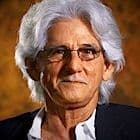
Interviews with Manuel Vázquez Portal
Cuba
The Black Spring
“The cell was three steps wide and seven long.”
Transcript
And in 1995 an old friend appeared. My old friend walked slow, swaggering a grand humanity with his huge belly. And of course his huge laughter, that of a bewitching poet. My friend’s name was Raúl Rivero[Castaneda]. And he came to convince me to join the Cuban Independent Press. [Raul Rivero Castaneda (1945 – ) is a Cuban writer and former political prisoner and dissident. He was a leading pro-communist figure known as the “Poet of the Revolution” before breaking with the Castro regime in 1989. He was among those imprisoned during the Black Spring crackdown in 2003.]
And so Raul and I and a group of former journalists from the official Cuban press founded the Cuba Press [an independent news agency founded by Raúl Rivero Castañeda]. From there we began the struggle; to do independent journalism. In [19]97, Raul and I parted ways, he continued at the forefront of the Cuba Press, and I founded the United Workers Group; this was also a journalistic group but with literary intentions as well to promote independent journalism and literature. And it was here, with the United Workers Group, where I was surprised by the Black Spring of 2003.
One afternoon a huge operation took place in my home, a cumbersome operation. Fourteen officers entered my house; they looked in the drawers; they overturned furniture. All they found in my home was some literature, ample poverty, and a desire to be happy with my son who was just nine years old at the time. At the end of the search, where like I told you they only found old poems, unfinished novels, badly written stories… well then they took me to the political police’s headquarters in Havana known as Villa Marista. There, they threw me into a filthy cell along with three common criminals who had been arrested by a [government] operation called the “Shield of the Village” which had the goal of eradicating drug trafficking.
And there I was with those three supposed criminals… it turned out that those three were actually some real Cubans struggling to survive as anyone would say. I don´t know if they were linked to drugs or not; of course in Villa Marista not only were there microphones in the walls, even the insects had microphones! And they were not going to tell me anything; I of course never knew whether they were actually drug traffickers or not. And I was there for about 30-something days from March 19 through April 23. Of course, on April 4 they had taken us to a sham trial, a sort of Tartuffe farce … very similar to Moliere…very theatrical… where we went without any procedural guarantees and were sentenced to between 13 and 28 years. [Tartuffe is the title of a theatrical comedy penned by French playwright and actor Jean-Baptiste Poquelin (1622 – 1673), who is better known as Moliere.]
I was condemned to 18 years; Raúl Rivero was condemned to 20; Normando Hernández was condemned to 25… and thus the number of years in prison grew to the trifling amount of 28…29 years. On the…22nd … 23rd of April we rode by in a “guagua” or a bus as it is called here [in Cuba], and they began to distribute us throughout all the prisons in Havana. While driving, we began to run out of island and I thought they were going to send me to Jamaica, and early in the morning we arrived in the town of Santiago de Cuba and we were assigned to Boniato prison.
One of the memories I have there is when Normando Hernández, who had hopped on the bus in the city of Camagüey, approached us and we were talking; they handcuffed us together because apparently there were too many prisoners. I had my hand in one of the cuffs and Normando’s hand was in the other and we thought that we’d share a cell, but the order of the upper political echelons were such that we were going to punishment cells for solitary confinement. [Normando Hernandez (1969 – ) is a Cuban independent journalist and human rights advocate. From 2003 to 2010, he was a prisoner of conscience after his arrest in the Black Spring crackdown. He has lived in the United States since 2011.]
Of course there was no light, no water. The cell was three steps wide and seven long; I remember. I measured them, and then I wrote a book called, Written Without Permission, which is a retrospective on this era of my life, the Black Spring, prison, etc…it begins by saying my cell is three steps wide; my cell is seven steps long. It was, it was narrower than arms outstretched for a hug. Actually, no one would enter that cell. They placed it on you like it was a shirt that was too small. And we began to see the reality of our situation. Of course the protests began; we had no access to the press, we had no access to television, the Internet…forget about it.
About Manuel Vázquez Portal
Born in 1951, Manuel Vázquez Portal grew up in the early days of the Castro regime. He received a degree in philology and worked for several years as a teacher. Afterward, he served as a literature advisor in the Ministry of Culture and a journalist with a state-owned media outlet. Through his work, he discovered first-hand how the regime used media and literature as propaganda and banned anything that challenged government ideology. Disillusioned with the regime’s censorship, Manuel focused his talents on children’s literature, a field that offered more flexibility for creativity and imagination.
In 1995, Manuel joined an independent news agency called Cuba Press, and in 1998, he helped form a similar organization called the United Workers Group. In 2003, Manuel was arrested along with 74 other nonviolent dissidents as part of a massive government crackdown known as the Black Spring. He was sentenced to 18 years in prison for his criticism of the regime. While incarcerated, Manuel worked with fellow political prisoners to organize protests against the prison guards and hunger strikes.
Also during this time, Manuel smuggled his diary out of prison with its descriptions of the conditions he and fellow prisoners endured; his testimonies were published for the outside world under the title Written Without Permission. The Committee to Protect Journalists presented Manuel the International Press Freedom award in absentia for his efforts to expose the regime’s treatment of political prisoners..
In 2004, Cuban authorities transferred Manuel from prison to a hospital; years of abuse and malnutrition had caused his health to deteriorate. Much to his surprise, Manuel was released and went into exile. He brought his family to the United States where he continues to champion a free and democratic Cuba.