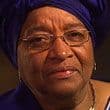
Interviews with Ellen Johnson Sirleaf
Liberia · Interviewed January 11, 2010
International Support in Prison
The powerful role of women human rights defenders in Liberia.
Transcript
The first time I went into prison, I was in prison with a lot of students, and the U.S. Congress took a very strong position on that. And, you know, the sense of the Congress was they were even going to cut off support because, you know, we had become a folk hero by taking the position I took against the military regime.
And so that rallied a lot of international attention and support and, ultimately, the U.S. institutions – some of the NGOs and all of those that rallied to the cause and wrote their congressman. And so that was very helpful.
And the second time, like I said, I was Vice President of Citicorp when I went home to form this political party; and then got into trouble then. And so, ultimately, I had to leave Citibank; but they rallied around me and got the banking community, the financial institutions to weigh heavily again through the U.S. Government to make sure that we got out.
And, frankly, the women in our country rallied too. I mean, you know, thousands and thousands of them wrote petitions, but that rallying domestically also brought a lot of international attention, international support. There were foreign journalists that went to cover this emerging drama, you know, of taking on a military regime; and that in itself brought a lot of pressure on the regime, and they perhaps helped to get us all – finally we all got freed.
About Ellen Johnson Sirleaf
Ellen Johnson Sirleaf is the president of Liberia. She was awarded the 2011 Nobel Peace Prize.
Sirleaf served as minister of finance in Liberia until the 1980 coup d’état by Samuel Doe. She left the country and served in senior positions with the World Bank and later Citibank.
Sirleaf returned to Liberia in 1985 and was arrested and imprisoned by the Doe government. After her release, she went into exile in the United States where she remained throughout a brutal Liberian civil war between the Doe government and a rebel group headed by warlord Charles Taylor. Following a peace agreement ending the war, Sirleaf returned home to run unsuccessfully against Taylor for the presidency. Taylor’s election has been attributed in part to a fear by the Liberian public that he would restart the war if he lost.
Following a second Liberian civil war, Taylor was exiled in 2003. Sirleaf again sought the presidency and was elected in 2005, the first woman democratically elected to serve as a head of state in Africa.
In 2008, Sirleaf published her memoir, “This Child Will Be Great.”