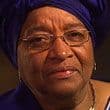
Interviews with Ellen Johnson Sirleaf
Liberia · Interviewed January 11, 2010
Gender Perceptions
The role played by women human rights defenders in Liberia’s democracy movement.
Transcript
There´s still respect for women. People still see women as their mothers and their sisters. And so there´s a little bit more tolerance, I think, in how women are treated. And our women tend, also, to network better and to support each other much better, particularly when a woman faces difficulties of getting into some trouble.
The disadvantages that women are still perceived to be the weaker sex and one who´s not going to make those hard decisions and do things, I don´t think it´s proven to be true in so many cases, my own included. But that is the perception and there are social barriers that give– that make women– put women at a disadvantage.
The same things you just can´t do because they´re socially taboo. You know, you can´t go around drinking a beer with somebody to talk about what you need to do. So you tend to be much more reserved and confined, and that perhaps limits the scope of the kind of interaction that you could have to achieve your objective.
About Ellen Johnson Sirleaf
Ellen Johnson Sirleaf is the president of Liberia. She was awarded the 2011 Nobel Peace Prize.
Sirleaf served as minister of finance in Liberia until the 1980 coup d’état by Samuel Doe. She left the country and served in senior positions with the World Bank and later Citibank.
Sirleaf returned to Liberia in 1985 and was arrested and imprisoned by the Doe government. After her release, she went into exile in the United States where she remained throughout a brutal Liberian civil war between the Doe government and a rebel group headed by warlord Charles Taylor. Following a peace agreement ending the war, Sirleaf returned home to run unsuccessfully against Taylor for the presidency. Taylor’s election has been attributed in part to a fear by the Liberian public that he would restart the war if he lost.
Following a second Liberian civil war, Taylor was exiled in 2003. Sirleaf again sought the presidency and was elected in 2005, the first woman democratically elected to serve as a head of state in Africa.
In 2008, Sirleaf published her memoir, “This Child Will Be Great.”