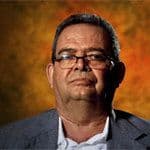
Interviews with Blas Giraldo Reyes Rodriguez
Cuba
Why I Became A Dissident
“And I tried to united the opposition.”
Transcript
In 1998, I decided to start working in the opposition directly; I was always a faithful listener of Radio Marti. And I was aware of everything that happened to the opposition inside Cuba. But as I was already a persecuted person, the son of an ex-political prisoner and the son-in-law of an ex-political prisoner, my family was persecuted.
I feared for my family, you know? So then in 1998, I decided to break with the system completely; to take off my mask, as we say in Cuba, and face the system with the truth. I never sympathized with the system, but neither was I acting against it. I was apolitical from the beginning of my childhood, because my father never let me be a Pioneer. I never belonged to the CDR (Committee For the Defense of the Revolution), I never went to the political speeches; I never went to any of the political meetings to help any of them in the system, you know?
[The Pioneers are the Communist Party’s organization for children. The Committees for Defense of the Revolution are neighborhood-based groups which monitor Cuban citizens’ activities and promote the Communist Party agenda.]
Then in 1998, I had to leave my work as a topographer, and go to work in the fields with farmers to provide for my family; [these were] very tough times, you know? In Sancti Spiritus, the first organization that I participated in is the CTDC, which is Council of Democratic Workers of Cuba, which was founded in the town of Ramón Lopez Peña.
I visited that town and there, through friends from my youth there in Lopez Peña, I joined the CTDC. Then in Sancti Spiritus, I founded the Ex-Captive Club of Sancti Spíritus, of political prisoners and family members who were part of it. There were many political prisoners in the area of Sancti Spiritus.
Even then, we began to be persecuted whenever we went out to meetings in Placeta, Santa Clara. They would take us from those places, when we were leaving the house, or at the train station that was close to my house. They would take us away and leave us long distances away from home; 100 or more kilometers from home, you know? So then, that’s when all those problems began.
Then on May 20, 2001, I founded the “May 20th #1″ [independent] library in Sancti Spíritus; and the problems continued against me and my family. My son was already big, because my son at that time was 16 … no … 15 years old. And he was studying in a school of economics. And he was harassed by a gentleman from State Security; if you can call him a gentleman, because those people are repugnant, you know? That man harassed him, saying things to my son.
These are difficult things, you know? But well, when a man faces a fight for the truth, you have to be ready for whatever comes. I always counseled my son, “Don’t answer him. Let him be. Let God be witness to all his wrongdoings.” Because of these things, my son already felt inferior to his other classmates. Because sometimes he didn´t understand things, you know? But I always reminded him that the system [in Cuba] did not work.
So, in Sancti Spiritus, I continued my peaceful struggle. My home was a meeting point, because it was in a very central location in town. My house was the meeting point of the opposition in Sancti Spiritus. I didn’t have problems. I got along well with everyone, you know?
And I tried to unite, not divide – unite the opposition, because a united opposition is a stronger opposition. When there are divisions in the opposition, you don’t get anywhere. The opposition ought to be united. Each one has his own ideas, because this is democracy; each with his own ideas and planting that which he believes good for the country.
And from all of this, you take the best – that’s my idea, my intention. I have always tried to do things this way; uniting and not dividing the opposition. It’s State Security that divides us. They say, “divide and conquer.” Unity is our strength. So I continued in the opposition there in Sancti Spritus.
About Blas Giraldo Reyes Rodriguez
Blas Giraldo Reyes Rodriguez was born in Manicaragua, Cuba. As the son of a political prisoner, the government forced Blas out of school at the age of 16. During the next three years of his life, Blas was pressed into military service where he performed forced labor. In 1975, Blas and his family were sent to live with his father in a penal colony, essentially a concentration camp for political prisoners, in Pinar del Río. While there, Blas met Isel Acosta, the woman he would marry.
In 1990, Blas moved to Sancti Spiritus with his wife and began working as a surveyor, but was unable to escape his family’s past as he was harassed by State Security. Inspired by Pope John Paul II’s visit to Cuba in 1998, Blas decided to become active in the Cuban opposition. He also started an independent library and became involved in the Christian Liberation Movement, an organization that spearheaded the Varela Project, a petition calling for a referendum on legal reform in Cuba with the goal of greater personal, political and economic freedoms. Blas was arrested for his activism in March 2003 and sentenced to 25 years in prison; he was one of 75 nonviolent dissidents incarcerated as part of a massive government crackdown known as the Black Spring. While imprisoned, he was kept in solitary confinement for long periods and subjected to abuse by the prison guards.
Blas was released along with fellow prisoners in 2010 as part of an agreement negotiated among Spain, Cuba and the Catholic Church. In 2011, he resettled in the United States where he lives today.