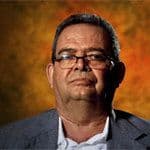
Interviews with Blas Giraldo Reyes Rodriguez
Cuba
Captive Villages
“It was a like a concentration camp.”
Transcript
In August of 1975, they assigned housing to my father in Pinar del Rio; so we are obliged to go live in the province of Pinar Del Rio in the captive village of Ramon Lopez Peña, which was once called San Carlos in the municipality of San Cristobal. When we arrived, it was very painful.
September 2 was the day that they took us on that big move to Pinar Del Rio; the westernmost province in Cuba. We were taken there by train.
[The captive villages were a system of camps established in 1960s by the Castro regime to imprison political opponents and their families from the Escambray Mountains region in central Cuba. Many of those who were imprisoned were active in anti-government uprisings in the years following the Cuban Revolution in 1959. The Cuban government refers to this insurgency as the War Against the Bandits; opponents call it the Escambray Rebellion. The government sent many of these people to Pinar del Rio, the westernmost province. Blas Reyes, whose father was active in anti-Castro insurgents, and his family were among those moved to the captive village of Ramon Lopez Pena. Reyes was 20 at the time.]
The captive villages in Cuba are the farmers of Escambray [province] who helped anti-Communist guerrillas. This was in 1963; they took farmers and brought them with their families to captive villages such as Sandinos, in Pinar del Rio. There is the town of Sandinos, Pinar del Rio, and there are several other towns in the province of Camagüey. There are other captive villages in Amarilla, Matanzas; in Remedios near the prison, near the military unit there; the 4th unit division of Remedios. In total, there are 17 captive villages in Cuba. Those are the families dislocated from Escambray.
Humble people, whose only flaw was that they were not sympathizers of the system; because they knew that it was a Communist system. So they were taken to these captive villages. Those men there had to build their homes. They took them to prison, but after prison, they put them into forced labor brigades. Some did construction, others worked on chicken farms, others in agriculture, but then there is a group of those young men who had to build housing for all those families.
So that’s what we called captive villages, which are filled with people locked in there, you know? It was like a concentration camp… They are concentration camps with difficult living conditions, as I told you earlier. They were flood-prone areas, that when it rained, the streets would flood. The flooded waters ran down the street.
Then, there were problems with hepatitis, because the sewage contaminated the drinking water. These are the captive villages. The families were also punished. You were punished just for being the son of someone who did not agree with the system. Their goal was to psychologically destroy the person because that’s how totalitarian communist systems are.
What they do is kill the person psychologically and they might not give punch you but it affects you more psychologically because the body heals, but the psychological part is more difficult to heal. Then we get psychologically tortured which stays in our brains. And that affects us for the rest of our lives. And that´s what they use. My father is alive; he will be 91 years old but already his mind is completely lost.
About Blas Giraldo Reyes Rodriguez
Blas Giraldo Reyes Rodriguez was born in Manicaragua, Cuba. As the son of a political prisoner, the government forced Blas out of school at the age of 16. During the next three years of his life, Blas was pressed into military service where he performed forced labor. In 1975, Blas and his family were sent to live with his father in a penal colony, essentially a concentration camp for political prisoners, in Pinar del Río. While there, Blas met Isel Acosta, the woman he would marry.
In 1990, Blas moved to Sancti Spiritus with his wife and began working as a surveyor, but was unable to escape his family’s past as he was harassed by State Security. Inspired by Pope John Paul II’s visit to Cuba in 1998, Blas decided to become active in the Cuban opposition. He also started an independent library and became involved in the Christian Liberation Movement, an organization that spearheaded the Varela Project, a petition calling for a referendum on legal reform in Cuba with the goal of greater personal, political and economic freedoms. Blas was arrested for his activism in March 2003 and sentenced to 25 years in prison; he was one of 75 nonviolent dissidents incarcerated as part of a massive government crackdown known as the Black Spring. While imprisoned, he was kept in solitary confinement for long periods and subjected to abuse by the prison guards.
Blas was released along with fellow prisoners in 2010 as part of an agreement negotiated among Spain, Cuba and the Catholic Church. In 2011, he resettled in the United States where he lives today.