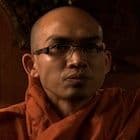
Interviews with Ashin Issariya
Burma · Interviewed January 8, 2010
Burmese Monks in Society
On the role of Buddhist monks in Burmese society.
Transcript
So now the SPDC [State Peace and Development Council] military regime is always trying to control everything. They want to keep their power always. They never want to give up their power. So they are only thinking of their power. So because in 1990, at the time of the past boycott in Mandalay, because a lot of people wanted to offer to the monks in Mandalay. In 1988, at that time a lot of students and a lot of monks had passed away. And then they offered their food for the monks.
And then a lot of monks, over 500 monks, collected the food. So SPDC is trying to close. They don’t allow to offer that ceremony. But they do. So they shoot the monks, and they beat and torture. At that time a lot of senior and junior monks were scared about it. The military regime is very cruel. So we don’t accept that idea. Our Buddha talked like this: ”If they do like this, we need to boycott.” Our Buddha’s teaching, we need to obey our Buddha’s teaching. We need to obey our rules.
So at the time they were trying to boycott in Mandalay 1990. But at the time the media is no good in our country. Because one radio only in a village. One village, one radio. Some villages never had a radio, so at the time they don’t know what is happening. Also that’s the case in Mandalay, that today they don’t know. But also, at the time they sent a lot of senior monks to the jail. And they beat and they tortured a lot. They never respected the monks, but they are pretending, “Okay, we respect the monks.” They offer robes, monasteries; whatever monks need, they supply. Because they are only pretend[ing]. Because in our country are 89 percent Buddhis[ts]. They know very well.
Because at the time they are pretending respect for the monks. At the time a lot of people are thinking, “Okay, our government respects our monks. It doesn’t matter whatever is it. Because they are very, very respect[ful] for the monk.” That’s the case. Military regime knows about it, they are very clever. So they are only pretending; they never respect. We know about it.
So at that time we explained a lot to the monks, more and more. Because some monks, they don’t know about it, because they don’t read. And at the time they don’t know that that’s the case, and they forgot it. So I shared a lot of information. When in 1990 our famous leader, senior monk, and there was respect for the monks a lot in the jail and they persuaded a lot. So we shouldn’t forget them.
Also, in our country most of the people are offering. Even though they are poor they support the monks. Whatever we need they support. So at the time we have a responsibility for them. If we can’t try to change our country’s system, their life is no good. They are very poor, and poorer day by day. Their children cannot attend school. Very big problem. Even though they cannot write their name [in their] mother language. So we are very sad. So we give education and we are trying to change our country’s system. It is our duty.
About Ashin Issariya
Venerable Ashin Issariya (“King Zero”) is a Buddhist monk from Burma. In 2007 he was a principal organizer of the nationwide protests that became known as the “Saffron Revolution.”
After the Burmese military regime used violence to break up a peaceful march by monks who were calling attention to poverty and starvation in the town of Pakkoku, Ashin Issariya and other monks organized nationwide protests against the violence. Over 100,000 monks and tens of thousands of ordinary citizens demonstrated in Rangoon, Mandalay, and other places throughout the country, often chanting Buddha’s teachings on “loving kindness”. The government responded with more violence, killing dozens of monks and other protestors and inflicting serious injuries on hundreds more.
Ashin Issariya became widely known in Burma and around the world under the name “King Zero”— which, as he explained in his Freedom Collection interview, meant that Burma should have no kings and no dictators. But it took the government some time to uncover his real identity, so he was able to spend several months assisting victims of Cyclone Nargis before fleeing to Thailand in 2008. He now lives in a monastery near the Thai-Burma border and remains in close touch with democracy advocates inside and outside Burma.