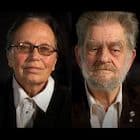
Interviews with Andrzej Gwiazda and Joanna Duda-Gwiazda
Poland
Vision for Poland
“Independence is absolutely necessary as a pre-condition for economic success.”
Transcript
JOANNA DUDA-GWIAZDA: I think that the paramount thing was that the economy should not be subordinate to any utopian ideology. That the economy should apply common sense, such methods, and such ideas which would simply be beneficial for the economy, and at the same time which allowed for continuous improvement in the living standard of the working people. And so that was the overall idea of the free labor unions.
ANDRZEJ GWIAZDA: Something worth noting – that in the free labor unions we met in small groups due to the security factor – there were five or six people. And so we conducted discussions, [saying] it is an obvious thing that you cannot demand more wages if you do not have a basis, an economic argument to back it up. So everybody would like to make more, but you have to have some grounds for it. So we encouraged people, and we told them about the method by which our colleagues were obliged to analyze, or give a rough analysis, at any rate, of the economic condition of their production plants. And this was met with a great deal of interest, and resulted in remarkably good success.
These young workers turned out able to decipher the economics of their employing plants remarkably well. So things would wind up more or less this way, that at the fifth or sixth session they would arrive with ready conclusions: “Andrzej, it makes no sense to be talking about free labor unions right now, what we’ve got to do is [silent expletive] get the heck away from the Soviet Union.” Because what turned out was that even in those plants which you would not have expected, they were forced to perform certain jobs practically free of charge for [supporting] the [communist] system. So in the free labor unions, every participant knew full well that independence is absolutely necessary as a pre-condition for economic success. And so we also conceived our own success along these lines: to overthrow the yoke of the power of the [Communist] Party secretaries, who were stifling the economy, its development, who stood in the way of that progress, it will result [positively] for Poland´s economy, Poland´s industry, and of course wages would spike way up.
So our assessment was that without any problem we could increase the living standard by a factor of three, to increase real wages threefold, without any danger of inflation. These were the reserves whereby, according to independent economists, 70 percent of the national product was sent out to serve the needs of the system, and only about 30 percent was left in the country, for our citizenry.
About Andrzej Gwiazda and Joanna Duda-Gwiazda
Andrzej Gwiazda, born in 1935 in Pinczow, Poland, and his wife, Joanna Duda-Gwiazda, born in 1939 in Krzemieniec, Poland, were prominent anticommunist opposition leaders in the 1970s and 1980s.
Andrzej studied electronics at Gdansk University of Technology and graduated in 1966. Joanna Duda graduated from the Gdansk University of Technology in 1963 with a degree in engineering and shipbuilding.
After marrying in 1961, Andrzej and Joanna became more active in opposition movements. Andrzej participated in the student protests against the Polish government in 1968; he also took part in the December 1970 demonstrations that were sparked by sudden increases in food prices. In 1976, the Gwiazdas wrote a letter to the Polish Parliament expressing their support for the Workers’ Defense Committee, an anticommunist underground civil society organization in the 1970s, formed to provide assistance to laborers and others persecuted by the government. Soon after, the Gwiazdas were officially banned from leaving Poland and were placed under surveillance.
In 1978, Andrzej helped to found the Free Trade Unions of the Coast and began publishing and delivering its bulletin, Worker of the Coast. Joanna worked as the bulletin’s editor. Andrzej was a member of the Presiding Committee of the Strike at Gdansk’s Lenin Shipyard in August 1980, a workers strike that attracted nationwide, popular support and forced the communists to the negotiating table. Joanna also participated in the Lenin Shipyard strike and, along with her husband, co-authored the 21 demands issued by the Inter-Enterprise Strike Committee to the communist authorities advocating for the establishment of an independent trade union and other workers’ rights. The government accepted these demands in what became known as the Gdansk Agreement.
In 1980, Andrzej became the Vice President of the Founding Committee of Solidarity, and served as the Vice President of Solidarity, the first independent labor union in the communist world that transformed into a nationwide freedom movement. Joanna was a member of the Regional Board of Solidarity in Gdansk until December 1981, when the Gwiazdas were imprisoned after the government declared martial law in an effort to crackdown on political opposition. Joanna was released in July 1982 and Andrzej was held in prison until May 1985.
While the Gwiazdas opposed the Round Table Talks that led to semi-free elections in 1989, believing that Solidarity shouldn’t meet the demands of a weakening Communist Party, they remained active in their opposition to communism until its collapse. They have since retired to Gdansk.