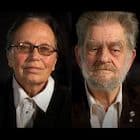
Interviews with Andrzej Gwiazda and Joanna Duda-Gwiazda
Poland
International Support
“The most important support was that of the moral and political variety.”
Transcript
JOANNA DUDA-GWIAZDA: Well, in the course of the strike itself what was important was moral or political support. Journalists would come over because the process in Poland was so well publicized throughout the world, and gave us protection. On the other hand, during the time of Solidarity [a labor union formed by Gdansk shipbuilders that transformed into a nationwide resistance movement], I am sure there was some assistance that arrived, but I don’t know.
ANDRZEJ GWIAZDA: Well, of course, of course. They were assisted by Western as well as Eastern [labor] unions: actually, there were several truckloads that came from the Japanese trade unions. So there was a very notable level of assistance, but the most important support really was that of the moral and political variety. And this was doubtless the most significant, we received [equipment for] printing shops, but unfortunately, due to the centralized paradigm which was applied, these got mostly destroyed at the outset of martial law by the riot police. So what got neglected was dispersed activities. The kind of activities that martial law would not be able to destroy.
About Andrzej Gwiazda and Joanna Duda-Gwiazda
Andrzej Gwiazda, born in 1935 in Pinczow, Poland, and his wife, Joanna Duda-Gwiazda, born in 1939 in Krzemieniec, Poland, were prominent anticommunist opposition leaders in the 1970s and 1980s.
Andrzej studied electronics at Gdansk University of Technology and graduated in 1966. Joanna Duda graduated from the Gdansk University of Technology in 1963 with a degree in engineering and shipbuilding.
After marrying in 1961, Andrzej and Joanna became more active in opposition movements. Andrzej participated in the student protests against the Polish government in 1968; he also took part in the December 1970 demonstrations that were sparked by sudden increases in food prices. In 1976, the Gwiazdas wrote a letter to the Polish Parliament expressing their support for the Workers’ Defense Committee, an anticommunist underground civil society organization in the 1970s, formed to provide assistance to laborers and others persecuted by the government. Soon after, the Gwiazdas were officially banned from leaving Poland and were placed under surveillance.
In 1978, Andrzej helped to found the Free Trade Unions of the Coast and began publishing and delivering its bulletin, Worker of the Coast. Joanna worked as the bulletin’s editor. Andrzej was a member of the Presiding Committee of the Strike at Gdansk’s Lenin Shipyard in August 1980, a workers strike that attracted nationwide, popular support and forced the communists to the negotiating table. Joanna also participated in the Lenin Shipyard strike and, along with her husband, co-authored the 21 demands issued by the Inter-Enterprise Strike Committee to the communist authorities advocating for the establishment of an independent trade union and other workers’ rights. The government accepted these demands in what became known as the Gdansk Agreement.
In 1980, Andrzej became the Vice President of the Founding Committee of Solidarity, and served as the Vice President of Solidarity, the first independent labor union in the communist world that transformed into a nationwide freedom movement. Joanna was a member of the Regional Board of Solidarity in Gdansk until December 1981, when the Gwiazdas were imprisoned after the government declared martial law in an effort to crackdown on political opposition. Joanna was released in July 1982 and Andrzej was held in prison until May 1985.
While the Gwiazdas opposed the Round Table Talks that led to semi-free elections in 1989, believing that Solidarity shouldn’t meet the demands of a weakening Communist Party, they remained active in their opposition to communism until its collapse. They have since retired to Gdansk.