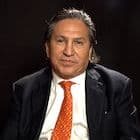
Interviews with Alejandro Toledo
Peru
Freedom and Democracy as Universal Values
“Democracy does not have a nationality. It’s a universal value, just as much as human rights.”
Transcript
And then I lost my mind. I got into politics. And then I formed a political party, Perú Posible. And with three former students of mine from Peru, I went to Japan to be a visiting scholar at Waseda University. I wanted to know the animal from within. And came back; I had to do this fight first to recuperate freedom and democracy in Peru. It was taken by [former Peruvian President Alberto] Fujimori, who changed the constitution three times and had a project of 30 years, including his family.
And so I became the leader of a democratic coalition. I have 19 death threats. One of them was – I forgot, this is the first time I’m going to say – one of them was ready to – was the day. Fortunately, people around me and some secret agents from other countries were able to detect they hired people from Colombia to shoot [me] one given night. Fortunately, they negotiated in Germany and Berlin for some exchanges and amnesty to life.
But I want to be very clear: I have deep, deep convictions. I’m an activist, an academic activist. And it’s not incompatible. It’s not incongruent. Conviction of freedom, democracy. And democracy’s not only practiced in one election day. Democracy we need to take care every day. And that involves a democracy that delivers concrete and measurable results so people believe in democracy; freedom to say what you believe; freedom of the press and the press that doesn’t sell its editorial line for a given cause as it was sold to Fujimori; human rights.
I belong to several organizations in the world and some board of directors. I have fought for 10 years to take this lady in Burma, Aung San Suu Kyi, and I just was last week in San Francisco, where she was decorated. [In September 2012, Burma’s most prominent pro-democracy leader, Aung San Suu Kyi was honored by the Human Rights Foundation at the Freedom Forum in San Francisco]. I went to some states of the former [Soviet] Union to give a speech on democracy, freedom, human rights.
Some people ask me, what in the hell are you doing in Burma or in Georgia, the country Georgia, if you have some troubles in Latin America? And yes, my answer is, democracy does not have a nationality. It’s a universal value, just as much as human rights doesn’t have skin color. And they could try to cut my tongue or try to cut my arm, but they will never stop my convictions. Freedom. I am today free thanks to education. I chose to give you this interview. I have the option. Education provides you freedom.
About Alejandro Toledo
President Alejandro Toledo was the first person of Quechua decent to be elected president of Peru, serving from July 2001 to July 2006. Toledo grew up in a large, poverty-stricken family that struggled to support itself. As a young boy, Toledo saw the value of education and became involved in politics and journalism at the age of eleven.
In 2000, Toledo was a leading figure in the movement that toppled President Alberto Fujimori’s authoritarian regime. Following Fujimori’s controversial re-election, which was surrounded by fraud allegations, Toledo organized mass street protests that ultimately forced the President’s resignation. Toledo emerged victorious in Peru’s subsequent presidential election in April 2001.
As president, Toledo implemented policies to reduce poverty by investing in the country’s health and educational systems. As a result of sustained economic growth and deliberate social policies directed at assisting the poor, extreme poverty was reduced by 25 percent in five years.
Since leaving office, Toledo has continued to be a leading voice in international development. He recently founded the Lima-based Global Center for Development and Democracy; through this organization, Toledo works to promote sustainable democracies and economic self-sufficiency in the developing world.