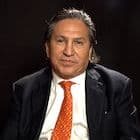
Interviews with Alejandro Toledo
Peru
Background
“Seven of my brothers and sisters died the first year of their life.”
Transcript
I come from the Andes, the mountains, high altitude of 12,000 feet above sea level, born in extreme, extreme poverty. [The Andes are the longest continental mountain range in the world, spanning the western coast of South America through Venezuela, Colombia, Ecuador, Peru, Bolivia, Chile, and Argentina.] I’m one of 16 brothers and sisters, 14 brothers and two sisters, six twins. I’m not a twin. Very typical of the statistics of extreme poverty in Latin America, in Africa and other developing regions. Seven of my brothers and sisters died the first year of their life because we did not have access to potable water, sanitation or access to health care, much less to a quality of education.
Very typical of what happened in Latin America during the ’50s and the ’60s. There was a huge rural-urban migration. So my parents migrated from the mountains where we worked in agriculture and, you know, have just sheep and – sheeps and pigs to survive. My parents decided to migrate to a port north of Lima [Peru’s capital] called Chimbote. It’s a very predominant, huge port.
When we migrated we lived in a shantytown. And we had to work to supplement the family income because we were nine, my parents 11, my grandfather, so we were 12 in one room, a room that was a kitchen, living room and a bedroom. I have to say that I’m proud of having been became mature too early. During the day I went to school. In the night I went to shoeshine – I was a shoeshine boy. I sold the newspaper and lottery at the same time, not only me but my other brothers, to supplement the family income.
We became entrepreneurs very early, six, seven years old. I was selling ice cone, and sometimes we didn’t sell anything because the sun comes, people didn’t buy it. So I saw that my ice converted in water, and it was dropping into the floor. We would not get an income. We had different types of jobs. Moreover, we became prematurely adult by going at 7, 8 years old to the prostitution house, because there the clients want us to shoeshine their shoes and the shoes of their partners.
I met a couple of Peace Corps volunteers, Joel and Nancy Meister. That was the years of the ’60s, ’62, ’63, when the Peace Corps and John Kennedy put an emphasis on community development programs. And they were supposed to live in the shantytown that they were assigned to work on community development.
And I got a scholarship to go to the University of San Francisco in California, USF, a nice, clean Jesuit university.
From there I had intensive English courses. I played professional soccer to supplement my income during the day. I studied economics and business administration.
Then typical Alejandro Toledo, always shoot the moon. I went up. And I applied to six universities: Harvard, MIT, Yale, Princeton, Columbia, London School of Economics, Stanford and Wisconsin. And out of the six, I was accepted in five.
To make the story short, I decided to stay in the Bay Area, and I went to Stanford. And then I did two master’s, one straight economics, another human resources and a Ph.D.
About Alejandro Toledo
President Alejandro Toledo was the first person of Quechua decent to be elected president of Peru, serving from July 2001 to July 2006. Toledo grew up in a large, poverty-stricken family that struggled to support itself. As a young boy, Toledo saw the value of education and became involved in politics and journalism at the age of eleven.
In 2000, Toledo was a leading figure in the movement that toppled President Alberto Fujimori’s authoritarian regime. Following Fujimori’s controversial re-election, which was surrounded by fraud allegations, Toledo organized mass street protests that ultimately forced the President’s resignation. Toledo emerged victorious in Peru’s subsequent presidential election in April 2001.
As president, Toledo implemented policies to reduce poverty by investing in the country’s health and educational systems. As a result of sustained economic growth and deliberate social policies directed at assisting the poor, extreme poverty was reduced by 25 percent in five years.
Since leaving office, Toledo has continued to be a leading voice in international development. He recently founded the Lima-based Global Center for Development and Democracy; through this organization, Toledo works to promote sustainable democracies and economic self-sufficiency in the developing world.