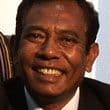
Interviews with Fernando "Lasama" de Araújo
East Timor · Interviewed January 8, 2011
Timor-Leste Self Determination
“We worked together in order to democratize Indonesia and to achieve self-determination for East Timor.”
Transcript
So each time the Indonesian flag was raised, we also raised the Timorese flag, to signify that we worked together in order to democratize Indonesia and to achieve self-determination for Timor-Leste. This was one of the actions which we Timorese students developed together with the Indonesian students. And I could say that perhaps Timor-Leste would not have achieved its goal of self-determination even until today, had the Indonesian regime remained the same. Had Soeharto remained in power in those times, had the democratization process not begin in Indonesia, then Timor-Leste would not have managed to obtain its self-determination either.
And then, after Soeharto stepped down from power, as everyone knows, Habibie took over from Soeharto and that was a time, which was very difficult for President Habibie. But he gave two options to Timor-Leste, that is, to choose via a referendum, either to be independent, or to get an extensive autonomy within Indonesia. It would be up to the people, who would decide. Personally, in those times, I felt that Timor’s Liberty started at the time when Habibie declared, or gave us those two options in the referendum: autonomy, or independence. For me, our independence started at that time. I was convinced that if there was going to be a referendum, then the people of Timor-Leste will not choose integration with Indonesia. The people of Timor-Leste would choose self-determination.
It was in those times that I experienced a very great joy because the light of our self-determination started to beam then, when Habibie uttered the words, giving the two options to the people of Timor-Leste.
About Fernando "Lasama" de Araújo
Fernando de Araújo (1963 – 2015), also known as “Lasama,” was a politician from East Timor.
He was born in 1963 in a mountainous district of what was then Portuguese Timor. In 1975, East Timor was granted independence by Portugal, but Indonesia invaded the country and claimed it as an Indonesian province until 2002. During the 1975 Indonesian invasion, Araújo saw the Indonesian Army kill 18 members of his family.
As a university student, he became an activist for Timorese independence and was selected as the first secretary general of the East Timor Students’ National Resistance (RENETIL). As a result of his student activism, he was arrested in 1991 and taken to Jakarta where he was tried and sentenced to six years and four months of imprisonment.
After his release, Araújo remained in Jakarta and continued to work for self-determination and democracy in East Timor, working closely with Indonesian human rights defenders and democracy advocates. He returned to Timor and in 2001 and founded and led the Democratic Party.
He was an unsuccessful candidate for the presidency in the April 2007 elections. In the June 2007 legislative elections, he was elected to parliament.
Araújo was elected President of the National Parliament in 2007 and served in that role until 2012. In 2008, he briefly served as acting president after an attempt on the life of President José Ramos-Horta. From 2012 to 2015, he served as Deputy Prime Minister, and was named Minister for Social Affairs and Education in April 2015.
He died from a stroke on June 2, 2015.