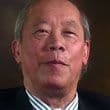
Interviews with Doan View Hoat
Vietnam · Interviewed January 7, 2011
Dangerous Laws
On how the Vietnamese government restricts freedom of expression and other fundamental rights under the rubric of “rule of law”, and on how democratic governments should reject this technique.
Transcript
I don’t think that the democratic governments or United States government sends a message that you don’t have to open the freedom or to accept freedoms, political freedom or cultural freedoms, so that you can receive our financial aid, for example. I don’t think that they send that clear message. But they also don’t send a clear message that you have to open up politically to receive our financial aid. What I mean is they try to balance between influencing Vietnam and not pushing for changes openly. That’s what they are trying to do.
But I don’t think that is effective. At least for a short time, it is not effective. And it continues to help the dictators, the Communist dictators, to try to find a way to slow down or at least not to speed up any political or culture changes. Try to find a new way to oppress those who demand for freedom. What I mean by new ways is, I have a term for that: I think that they are trying to legalize the violation of human rights by creating laws. But through the laws, they limit the freedoms of the people, instead of open or accept it.
Even in the constitution, for example, they have a chapter of civil rights. The people have all the rights. But in each article, almost each article of that chapter, there is just some words at the end of the article: it says that, “According to the law.” That means you have a right of freedom of expression according to the law. Now, the “according to the law” is not constitutional. The constitution, as we know, must be above all the laws, not defined by the laws.
So this is the basic thing that I think the United States and democratic governments have to pressure for change. That means there is no law that can limit the constitutional rights of the people. Now, in the constitution, they should take out those words. That’s the thing I think we need to pressure for change. What I mean is legal improvements; legal system must be our focus. Lawyers must have the right to defend any prisoner, any people who are accused by the government.
Lawyers must have the right. And the legal system must be independent from the government control. And the constitution must be a real constitution. And laws must be set up so that the people’s rights must be respected instead of limited. That means now we have to focus on legal change before political change.
About Doan View Hoat
Doan Viet Hoat is a writer, scholar and former longtime prisoner of conscience from Vietnam. He has been called “the Sakharov of Vietnam,” a reference to Soviet dissident and Nobel Peace Prize winner Andrei Sakharov. Hoat protested the South Vietnamese government’s suppression of certain Buddhist religious leaders in the 1960s while still a student.
In April 1975, when North Vietnam took over South Vietnam, Hoat remained in Vietnam. He was imprisoned in 1976 when the Communist government embarked on mass arrests of South Vietnamese intellectuals.
He spent the next 12 years in a cramped cell shared with 40 other prisoners.
Upon his release, Hoat began publishing an underground magazine entitled Freedom Forum (Dien Dan Tu Do). After a few months, he was arrested and detained without trial for two years. In March 1993, he was sentenced to 20 years in prison for “attempting to overthrow the people’s government.” Throughout his imprisonment, Hoat continued to issue statements on democracy and to offer criticisms of the regime that were smuggled out of prison. He was then sent to a labor camp in a remote part of the country where he spent four and a half years in solitary confinement.
In 1998, after intense international pressure, Hoat was released and sent into exile. He now lives in the United States and continues his activities to promote human rights and democratic reforms in Vietnam.