Remarks · April 12, 2011
Remarks by President George W. Bush at "The 4% Project: Driving Economic Growth"
"We believe America is the most innovative, productive, entrepreneurial country in the history of the world. And we believe with the right policies and the right attitude, we’re forever going to be a great economic power for the good of the world."
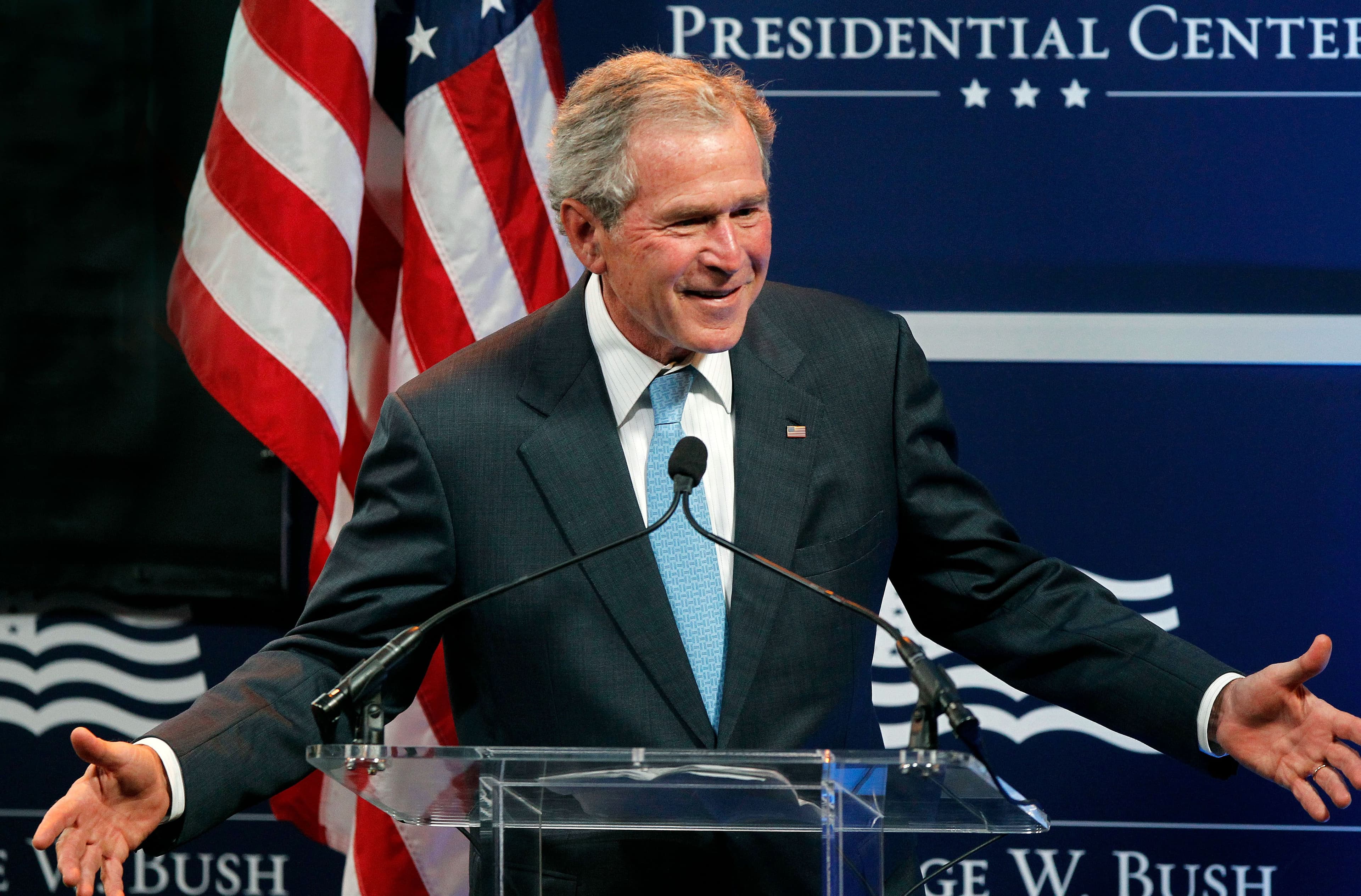
Thank you all. Please be seated. Welcome, and thanks for coming. It is my pleasure to educate you on what we’re doing at the Bush Center.
Laura and I decided to put our museum, institute, and archives here on the campus of SMU because it is an exciting, fabulous university in the heart of the promised land.
[Laughter.]
And to this end, I want to welcome Gerald Turner, the president of SMU; Dean Niemi, the dean of the Cox Business School. I welcome SMU students. As I understand it, the mighty SMU debate team is here. We welcome you as well.
I am thrilled to be associated with this really good university. And I think for those of you who are outside of Texas and Dallas, if you take time to find out about what’s going on at SMU, you too will be impressed.
I want to welcome Mark Langdale, who’s the president of our foundation. Mark’s job is to oversee the archives, the museum, and the institute. I’m proud to announce that we have paid for the building that is going up here on this campus. And I want to thank the supporters who are here for generously donating. And for those of you who haven’t yet generously donated, there’s still room for you.
I want to thank Jim Glassman. You know, as we set up this institute, I wanted it to be a non-political place of thought and action. Truth of the matter is, I’m through with politics. I’m interested in politics kind of like I’m interested in following the Texas Rangers. But I had my time on the stage, and I think it’s best for the country for former presidents to get off the stage and wish their successors all the best.
However, there are some principles and policies that Laura and I remain passionate about. Now, the Bush Institute will only survive and thrive if it—turns out—it’s not about me or my presidency, but in fact embraces certain universal principles that have stood the test of time.
One of which is freedom is universal. Laura and I believe—and many associated with our institute believe—that freedom is the desire of every man, woman, and child on the face of the Earth. I believe that the spread of freedom is in the nation’s interests. I believe democracies help yield the peace that we all want. And therefore, one of the parts of the Bush Institute is to encourage the advance of freedom.
We also believe that women will lead the freedom movement in the Middle East. And therefore, we’re going to spend a lot of time and focus on Middle Eastern women. To this end, we had an Afghan women’s business conference here at SMU, letting the Afghan women know we care about them, we do our best to make sure they don’t get abandoned, and we want to help.
Secondly, a principle is that all life is precious. And therefore, one of the areas of the institute is to help save lives on the continent of Africa. One of the initiatives I’m very proud of during my presidency was what’s called PEPFAR. It’s the AIDS initiative. It’s an initiative that measurably saved a lot of lives. And we think that we can help the private and public sector spend money better to this end. Mark Dybul, who led the PEPFAR effort, is now one of our fellows in the health area of the institute.
Thirdly, if you believe all life is precious, then you better be worried about whether all children are educated in America. I am a fierce defender of accountability in the public school system, embodied in the No Child Left Behind Act. To this end, not only do we defend accountability in public schools and promote reform, we’re also working to make sure principals are better recruited and better trained and better skilled with using accountability to advance educational excellence for all children.
And finally, a principle was that people can spend their money better than the government can. Now, that was—you know—kind of irritated some of the sophisticates when I would say that. But the truth of the matter is, it is a cornerstone of a lot of the debate that’s going on in Washington, D.C. And frankly, it is a part of what’s going to be discussed here today.
I want to thank our panelists for coming. We’ve assembled an extraordinary group of people. And thankfully, we’re in Dallas, which is an easy place to get to. But nevertheless, it did take a lot of effort to get here, and all of us are grateful that you’ve come.
I particularly want to pay homage to the Nobel Prize winners that have come. I told the people that are supporters of our institute that, you know, a former president has the capacity sometimes to attract pretty good talent. I rest my case. And we’re thrilled you’re here.
And I want to thank Meg Whitman, who’s our speaker this afternoon. Thanks for coming from California. Art Laffer is coming as well for tomorrow. And we’re honored you’re here and appreciate it very much.
People always ask, “Do you miss Washington?” I say, “Not really.” You know, I really don’t. You know, I miss being pampered. I actually had to stop at a couple of red lights getting over here today.
I miss being the commander in chief. To this end, later on this month I’ll be riding across the deserts of Texas with wounded warriors who have lost a limb during the War on Terror, to show America the unbelievable character of our men and women in uniform. I’m just hoping I can make it. It’s a 100-kilometer ride in the desert. And it’s not like a leisurely ride. It is a ride to herald people who got dealt a severe blow and said, “I’m not going to let it tear me down.”
Just imagine what this is going to be like. I’m really excited.
I miss being the commander in chief, and I miss my pals. I look around the room and I see a lot of people with whom I was fortunate to serve. And I was constantly amazed at the character of the person who agreed to set aside comfort to go to Washington to serve our country. I’m thrilled to see some of them here.
People here helped me pass tax cuts. Some of them here promoted free trade aggressively and successfully. And some of them here helped me make one of the toughest decisions I had to make as president—one of the most difficult decisions—a decision that contradicted a principle I told the American people I stood on, which is that markets are the best way to allocate goods, resources, and services.
And that decision was to use taxpayers’ money to bail out Wall Street in order to make sure that we didn’t have an economic disaster.
You know, I can’t prove that we were going to have an economic disaster. I can just tell you we didn’t have one. And I thought often about this decision. I will just tell you this: had I had to make it again, I’d have made the same exact decision.
And I appreciate those in the audience who were there in the White House during this period of time. And now the question is—you know—people talk about legacies. Presidents can’t shape legacies. It’s over. It’s done. I made the decision. The question now is: are we going to learn from the decision? The reason I had to make the decision—will we learn the causes of the financial near-disaster? Will we unwind government involvement as quickly as possible, which we at the Bush Center think ought to happen? And will we focus on growth and not regulation, which is what this conference is really about.
I’m amazed to hear yet again people saying, “Well, America’s greatest days are over.” I don’t know if you’ve heard it. It’s beginning to kind of creep into the national dialogue—this kind of psychological hand-wringing about, you know, our days are past.
And I kind of did a little research on it. It’s really interesting. At the turn of the century, here’s what one scholar said: “The era of individualism, liberalism, democracy, of humanitarianism, and freedom is nearing its end.”
In the late ’50s, the Sputnik crisis caused many in our country to say "there’s no way the U.S. can compete with the Soviet Union." In the ’70s, there was talk about malaise. In the ’80s, here’s what one official said—associated, by the way, with people in my political party. This guy was, I think, either a member of 41’s or 40’s administration. He said, “The American Century is over. The big development in the latter part of the century is the emergence of Japan as a superpower.”
You know, we hear the same talks today as to whether or not the United States will be able to compete with India and China and Brazil. My attitude—and I think the attitude of most people here—is that not only can we compete, we will compete.
And not only do we not view the world as zero-sum, we view it as a great opportunity. Those who think America’s days of economic greatness are over are wrong, in my judgment. Obviously, we’ve got to be somewhat optimistic to aim for an aspirational target of four percent. But you know, I remember one old boy saying to me, “Aim low—they’re riding Shetlands.”
[Laughter.]
We at the Bush Center aim high because we believe in the greatness of America. We believe America is the most innovative, productive, entrepreneurial country in the history of the world. And we believe with the right policies and the right attitude, we’re forever going to be a great economic power for the good of the world. And that’s what this conference is all about. I am delighted you were here. Thank you for coming.
I’m looking forward to the results. I look forward to having dinner with you tonight. Appreciate your time.
[Applause.]