The 4% Project: Driving Economic Growth
This conference launches the 4% Project, which will increase awareness of public policies and private business strategies that increase opportunity and prosperity for Americans.
Event
April 12, 2011
12:00 am - 7:00 pm
James M. Collins Executive Education Center
Symposium
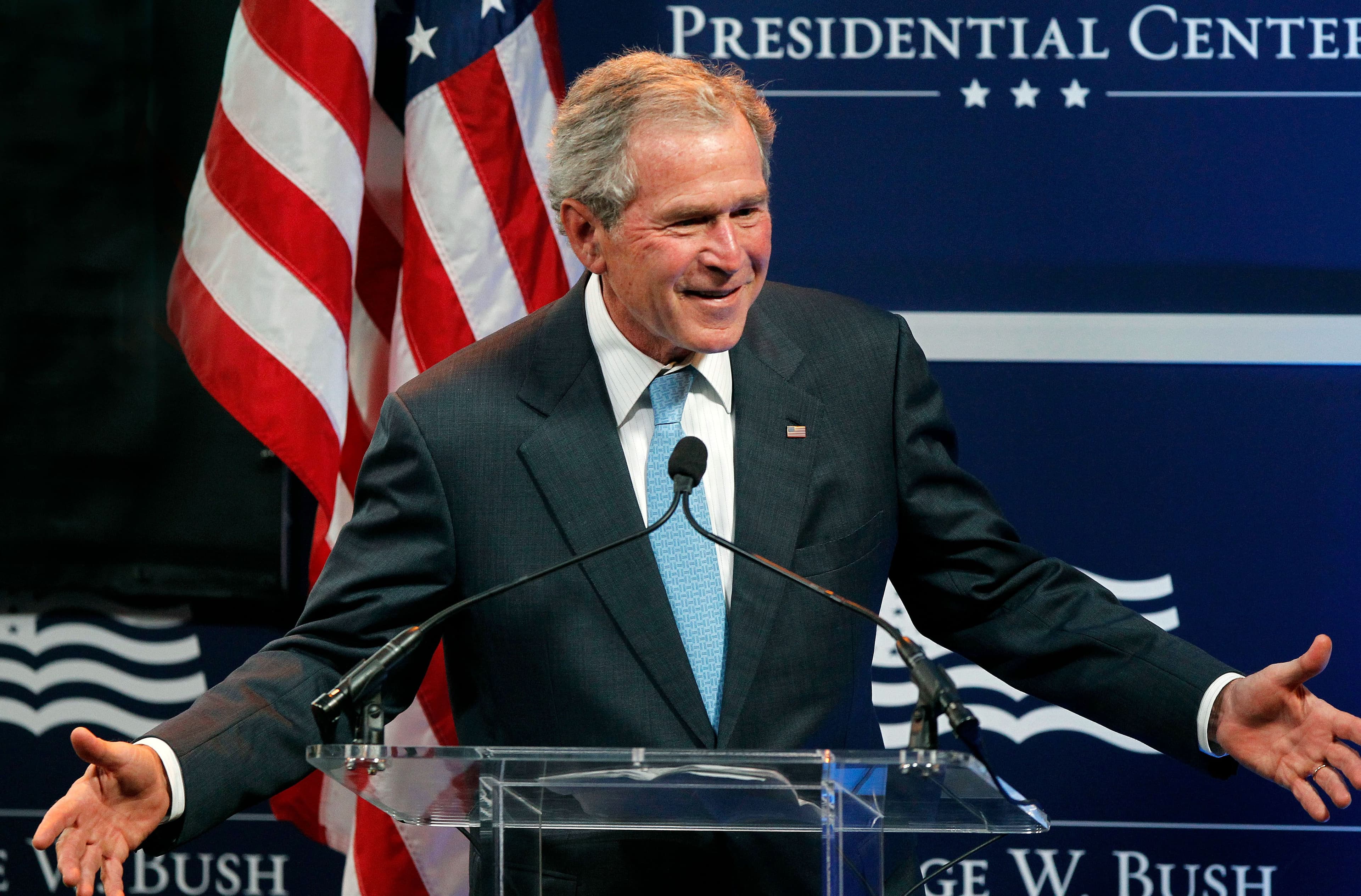
In the spring of 2011, the United States faces several economic challenges. But this is not a time for despair. Higher economic growth can overcome obstacles that seem daunting. While many economists foresee long-term GDP growth of just 2 percent a year, the Bush Institute, rooted in a strong belief in the power of free markets, seeks ways to double that rate.
The challenges are evident. The federal debt is moving to levels not seen since World War II. Unemployment rates remain high, with eight million fewer Americans working than just three years ago. One in seven mortgage debtors are on the way to foreclosure, and $12 trillion in household net worth has been wiped out since 2008. Gold prices have hit all-time highs above $1,400 per ounce.
History provides insight. One hundred years ago Argentina, a country blessed with abundant natural resources, was one of the wealthiest countries in the world, on a par with Britain, France and the United States. Today, Argentina’s per capita GDP is one-fifth that of the United States, and two-thirds that of Ecuador. A core lesson from Argentina’s long-term decline is that policy matters.
Our mission at the Bush Institute is to spur research and develop initiatives that will help accelerate America’s economic growth. This conference launches the 4% Project, which will increase awareness of public policies and private business strategies that increase opportunity and prosperity for Americans.
The conference sets for the United States a goal of long-term, sustainable, real GDP growth of 4 percent or more. While 4 percent annualized GDP growth might seem a stretch, it can be achieved. The United States grew at that rate during much of the 19th century, and the rate during the second half of the 20th century was only slightly lower.
With modern information and industrial technologies, as well as deep capital investment in productivity tools across the economy in every industry, the United States can grow much faster than economists currently predict – as long as the best policies are in place.
What are those policies? Nobel laureates and other leading economists, CEOs and policy experts have been invited to participate in discussions April 12 and 13 to begin the process of seeking answers to that question.
The stakes are high. In 2010, U.S. GDP was $14.6 trillion. At a 4 percent growth rate, GDP would reach $26.5 trillion in 2025. But at a growth rate of 2.4 percent, GDP would reach only $21 trillion – a 25 percent gap in wealth in just 15 years!
Strong growth will create a virtuous circle by lowering expected debt – and thus lowering the drag on the economy that excessive debt causes. Growth will also reduce unemployment and go a long way toward resolving the challenges of weakened retirement systems. America’s best days are ahead, but only if we can find a blueprint for increasing economic growth.
Schedule
Sessions
- April 12, 2011
Welcome and Opening Remarks: James K. Glassman, George W. Bush Institute
- April 12, 2011
Panel: How Does an Economy Grow? Government Policy and the Private Sector
Moderator
- Richard W. Fisher
President and Chief Executive Officer, Federal Reserve Bank of Dallas
Panelists
- Allan H. Meltzer
The Allan H. Meltzer University Professor of Political Economy, Carnegie Mellon Tepper School of Business - Jeffrey Miron
Senior Lecturer and Director of Undergraduate Studies, Department of Economics, Harvard University - Susan C. Schwab
Professor of Public Policy, University of Maryland; Strategic Advisor, Mayer Brown, LLP - Amity Shlaes
Syndicated Columnist, Bloomberg; Senior Fellow, the Council on Foreign Relations
- Richard W. Fisher
- January 03, 2026
Breakout Session: The Fed, Taxes and Spending -- The Choices Policymakers Face
- April 11, 2011
Breakout Session: Capital: Human and Otherwise: Education, Research and Technology
Moderator
- James Guthrie
Senior Fellow and Director of Education Policy Studies, George W. Bush Institute
Panelists
- W. E. Bosarge, Jr.
Founder and Chief Executive Officer, Capital Technologies, Inc.; Chief Executive Officer, Petrodome Energy, LLC; Co-founder and Chief Executive Officer, Quantlab Financial, LLC - Allan B. Hubbard
Co-Founder and Chief Executive Officer, E&A Industries, Inc. - Eric A. Hanushek
Senior Fellow, Hoover Institution of Stanford University - E. Floyd Kvamme
Partner Emeritus, Kleiner Perkins Caufield & Byers
- James Guthrie
- April 12, 2011
Breakout Session: Encouraging Entrepreneurship: America’s Comparative Advantage
Moderator
- Nick Schulz
Fellow, American Enterprise Institute; Editor-in-Chief, American.com
Panelists
- Peter G. Klein
Director of the McQuinn Center for Entrepreneurial Leadership and Associate Professor of Applied Social Sciences, University of Missouri; Research Fellow and Associate Editor, The Independent Review, The Independent Institute - Robert E. Litan
Vice President for Research and Policy, Kauffman Foundation; Senior Fellow in Economic Studies, Brookings Institution - Maria Minniti
Professor and Bobby B. Lyle Chair in Entrepreneurship, SMU Cox School of Business
- Nick Schulz
- April 12, 2011
Breakout Session: The Politics and Policy of Growth: How, in Practical Terms, Do We Get to 4%?
Moderator:
- Karl Rove
Former Deputy Chief of Staff and Senior Advisor to President George W. Bush; Author, “Courage and Consequence”; Columnist, The Wall Street Journal and Newsweek; Contributor, Fox News
Panelists:
- W. Michael Cox
Director, O’Neil Center for Global Markets and Freedom, SMU Cox School of Business - Lawrence B. Lindsey
President and Chief Executive Officer, The Lindsey Group - Maya MacGuineas
President, Committee for a Responsible Federal Budget; Director of the Fiscal Policy Program, New America Foundation - Jeff Madrick
Editor, Challenge Magazine; Visiting Professor of Humanities, The Cooper Union; Senior Fellow, The Roosevelt Institute and the Schwartz Center for Economic Policy Analysis, The New School
- Karl Rove
- April 12, 2011Watch ↗
Keynote Address: Meg Whitman, former President and CEO, eBay, Inc.
- April 13, 2011
Panel: The Nobel Economists’ Roundtable: What Do We Know – and Need to Know – About Boosting Growth?
Moderator:
- Edward P. Lazear
Professor of Human Resources Management and Economics, Stanford University’s Graduate School of Business; Senior Fellow, Hoover Institution of Stanford University; Senior Fellow (by courtesy), Stanford Institute for Economic Policy Research
Panelists:
- Robert E. Lucas, Jr.
1995 Nobel Laureate in Economics - Edward C. Prescott
2004 Nobel Laureate in Economics - Myron S. Scholes
1997 Nobel Laureate in Economics
- Edward P. Lazear
- April 12, 2011
Panel: The Business Leaders’ Roundtable: Growth, Jobs and Profits
Moderator:
- Robert K. Steel
Deputy Mayor for Economic Development, City of New York
Panelists:
- Greg Brenneman
Chairman, CCMP Capital - Stephen Friedman
Retired Chairman, The Goldman Sachs Group; Chairman, Stone Point Capital, LLC - James W. Owens
Senior Advisor, Kohlberg Kravis Roberts & Co.; Chairman and CEO Emeritus, Caterpillar, Inc.
- Robert K. Steel
- April 12, 2011
Closing Remarks: Arthur B. Laffer, Chairman, Laffer Investments Inc.
- April 12, 2011
Concluding Remarks and Adjournment: James K. Glassman, George W. Bush Institute